A video showing how to address biodiversity through Education for Sustainable Development and mobilise teachers, students, researchers and decision-makers to reflect on biodiversity issues and their interdependence with global sustainable development issues. It shows how education can help us better understand the value of biodiversity and the causes of biodiversity loss. It also gives examples of how educators and students can get active and help conserve biodiversity. It aims to increase public awareness of biodiversity issues by inspiring stakeholders, including young people, teachers and media professionals.
Monday, September 10, 2012
Learning to protect biodiversity
A video showing how to address biodiversity through Education for Sustainable Development and mobilise teachers, students, researchers and decision-makers to reflect on biodiversity issues and their interdependence with global sustainable development issues. It shows how education can help us better understand the value of biodiversity and the causes of biodiversity loss. It also gives examples of how educators and students can get active and help conserve biodiversity. It aims to increase public awareness of biodiversity issues by inspiring stakeholders, including young people, teachers and media professionals.


Tuesday, September 04, 2012
Thanks to Eric Woodard

Eric Woodard left the job of Executive Director of the U.S. National Commission for UNESCO to become Director for Fellowships and Internships at the Smithsonian. He has done a great job improving the information coming from the State Department on UNESCO and repopulating and reviving the National Commission. He will be missed!
From 2010: The UNESCO Senior Staff

- Jānis Kārkliņš, Assistant Director-General for Communication and Information;
- Lalla Aïcha Ben Barka, Assistant Director-General, Africa Department;
- Gretchen Kalonji, Assistant Director-General for Natural Sciences;
- Qian Tang, Assistant Director-General for Education;
- Getachew Engida, Deputy Director-General;
- Irina Bokova, Director-General;
- Hans d’Orville, Assistant Director-General for Strategic Planning;
- Francesco Bandarin, Assistant Director-General for Culture;
- María del Pilar Álvarez-Laso, Assistant Director-General for Social and Human Sciences;
- Khadija Ribes Zammouri, Assistant Director-General for Administration;
- Eric Falt, Assistant Director-General for External Relations and Public Information.
- Absent from photo: Wendy Watson-Wright, Assistant Director-General and Executive Secretary of the Intergovernmental Oceanographic Commission (IOC)
Friday, August 24, 2012
Officers of Americans for UNESCO
Americans for UNESCO has recently elected a new slate of officers. The full slate of AU officers consists of:
President Mary Futrell
Senior Vice-President Ray Wanner
Vice-President Susie Rauch
Vice-President Emily Vargas-Baron
Vice President/Treasurer Richard Nobbe
Secretary Laura Engel
Thursday, August 23, 2012
New UNESCO-Pepsi Partnership
UNESCO recently announced their intention to sign an agreement with Pepsi that will create a partnership designed to promote vocational training for young people in Burma.
Our Ambassador to UNESCO David Killion released a statement praising this vitally important partnership between UNESCO and a major U.S. Corporation, which you can see here.
Fall 2012 Laura Bush Travelling Fellowship Deadline Approaching

If so, please let them know about the Laura W. Bush Travelling Fellowship. This program named in honor of our former First Lady is designed to help young Americans conduct short term research projects abroad relating to the sectors of UNESCO's mandate.
The next application deadline is Monday 9/24/12. Find out more here.
Meeting of the National Commission scheduled.
 |
| 2011 U.S. National Commission for UNESCO Annual Meeting |
The Commission will again be accepting the hospitality of George Washington University, as it did last year.
Wednesday, August 22, 2012
A World of science Vol 10 n°3

If beauty is in the eye of the beholder, so too is utility. As Iain Stewart from Plymouth University
(UK) observed last February at the 40th anniversary of the International Geoscience Programme
(IGCP) at UNESCO in Paris, show a piece of coal to an industrialist and they will see a source of
fuel; show it to an ecologist and they will see a source of carbon emissions; show it to a geologist
and they will see a climate which existed more than 300 million years ago (Ma).
Geoscientists help us to travel through time. The IGCP was founded in 1972 to confirm the
existence of Gondwana, one of two megacontinents with Laurasia which formed about 145 Ma,
by correlating the geology of modern continents. As time went by and supporting evidence for
Gondwana became overwhelming, IGCP research teams turned to questions of special societal
relevance. New disciplines emerged like archaeoseismology, which draws on both the geological
and archaeological record to identify past earthquakes. One IGCP project in 2000 was even at
the origin of a new field: medical geology, the science dealing with the impact of our natural
environment on human and animal health. Arsenic, for example, is a natural chemical which poisons
millions of people worldwide who absorb it unwittingly through groundwater.
Given the concern over climate change and the looming shortage of fossil fuels and uranium
which overshadows our industrial future, geoscientists are focusing more on renewable energy these
days. Kenyan geoscientists, for instance, are currently employed on a government project to develop
geothermal energy in the Great Rift Valley.
A Call to Action: Forest Whitaker encourages youth to speak out
http://www.planwithyouth.org
Forest Whitaker, UNESCO Goodwill Ambassador for Peace and Reconciliation and a co-founder of the International Institute for Peace, sends an inspirational message to youth everywhere, encouraging their participation in the online discussions for the upcoming Policy Forum on 'Engaging Youth in Planning Education for Social Transformation'. This virtual, pre-forum dialogue is important becauseit will shape the discussions at the event in Paris, ensuring that voices of youth are included in the Policy Forum's Agenda for Action.
Wednesday, July 18, 2012
Task Team Report: Realizing The Future We Want For All
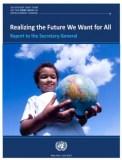
In this report, the UN System Task Team lays out a vision for transformative change towards the future we want. The report was prepared to inform the open and inclusive consultations that are taking place in preparation for an ambitious development agenda beyond 2015..
Overview
Enormous progress has been made towards achieving the MDGs. Global poverty continues to decline, more children than ever are attending primary school, child deaths have dropped dramatically, access to safe drinking water has been greatly expanded, and targeted investments in fighting malaria, AIDS and tuberculosis have saved millions.
The MDGs are making a real difference in people’s lives and, with strong leadership and accountability, this progress can be expanded in most of the world’s countries by the target date of 2015.
After 2015, efforts to achieve a world of prosperity, equity, freedom, dignity and peace will continue unabated.
The UN is working with governments, civil society and other partners to build on the momentum generated by the MDGs and carry on with an ambitious post-2015 development agenda.
At the September 2010 MDG Summit, UN Member States initiated steps towards advancing the development agenda beyond 2015 and are now leading a process of open, inclusive consultations on the post-2015 agenda. Civil society organizations from all over the world have also begun to engage in the post-2015 process, while academia and other research institutions, including think tanks, are particularly active.
Secretary-General Ban Ki-moon has established a UN System Task Team to coordinate preparations for beyond 2015 and to support the work of a High-level Panel that the Secretary-General will appoint to advise him on the post-2015 agenda. President Yudoyono of Indonesia, President Johnson Sirleaf of Liberia and Prime Minister Cameron of the United Kingdom have accepted the Secertary-General's invitation to co-chair the High-level Panel.
The post-2015 agenda will reflect new development challenges and is linked to the outcome of “Rio+20” -- the UN Conference on Sustainable Development -- that took place in June 2012 in Rio de Janeiro, Brazil.
UNESCO contributed to the report. Check the UN website providing a number of resources related to the task force report.
Sunday, July 08, 2012
UNESCO: Building Equitable, Inclusive Green Societies
Irina Bokova, Director-General, UNESCO.
Click here for more on UNESCO's support for sustainable development and Rio + 20, The Earth Summit.
Sunday, June 10, 2012
Learning to address climate change
The newly released UNESCO video "Learning to address climate change" shows in four minutes why climate change education is important to shape sustainable development and how it works in practice.
It shows how education can help us understand the causes of climate change. It also gives examples of how teachers and students can get active and address the challenges of climate change.
The War On Doping - Trailer
In the run up to the opening of the 30th Olympic Games of modern times, in London, the United Kingdom, from July 27 to August 12, UNESCO will host, on June 7, 2012, a first-ever pre-release screening of the documentary film "The War on Doping." The film presents the first decades in the campaign against doping in sport.
This is a trailer of the one hour documentary about the fight on doping in sports. It shows some of the faces involved and touches some of the issues that has been going on for more than 40 years. In this film, and for the first time, the world's most respected authority in the subject, the renown doping hunter, Professor Arne Ljungqvist, will guide us through all of them. The big scandals. The big names. The inside story. A mirror of society.
More information: http://www.unesco.org/new/en/social-and-human-sciences/themes/anti-doping/sv15/news/one_month_before_the_launch_of_the_london_olympics_unesco_hosts_the_pre_release_screening_of_the_film_the_war_on_doping/
Saturday, June 09, 2012
UNESCO-IHE Fieldwork Coastal Engineering
In June 2011 UNESCO-IHE Coastal Engineering students participated in a five-day fieldwork exercise at the coast of the Netherlands. The fieldwork is funded by the Building with Nature programme and focuses on swimmer safety around the mega sand nourishment that is currently being completed between Hoek van Holland and Kijkduin.
See also:
Coastal Zone and Port Development specialization page: http://www.unesco-ihe.org/hecepd
Website Building with Nature Programme: http://www.ecoshape.nl
Thursday, May 24, 2012
Friday, May 18, 2012
Future water scenarios
William J. Cosgrove is Senior Adviser to the UN World Water Assessment Program for the 4th edition of the United Nations World Water Development Report and the Manager of the World Water Scenarios Project. Mr. Cosgrove is a former vice president of the World Bank, past-president of the World Water Council, and served as chairman of the International Steering Committee of the Cooperative Program on Water and Climate. He was one of the panelists in the UNESCO Future Forum on Global Water Futures 2050+ held on 12 April 2012.
Water Expert Appointed to National Commission
 |
| Commission member Rich Meganck on the Upper Deschutes River in Central Oregon |
Newly appointed to the U.S. National Commission for UNESCO is Richard Meganck.
After a 34 year career in international development, including a 6.5 year stint as Rector for the UNESCO Institute for Water Education in Delft, the Netherland, Rich has resettled in Oregon with his spouse Janet and their three Pacific Northwest based daughters.
Besides his new appointment to the Commission, Rich serves as a member of the U.S. Committee for the International Hydrological Program and is a part-time Fellow at the Institute for Wather and Watersheds at Oregon State University with the support of the U.S. Army Corps of Engineers institute for Water Resources (IWR) in association with its International Center for Integrated Water Resource Management UNESCO Category II Center (ICIWaRM). Rich is also consulting with the Brazilian Government to develop a new UNESCO Category II Center in the State of Minas Gerais.
Synchrotron-light for Experimental Science and Applications in the Middle East (SESAME)

Next week our Ambassador to UNESCO David Killion will be attending a meeting about SESAME, the Middle East's first major multi-country scientific research center, which is being developed under the auspices of UNESCO. You can read more here.
UNESCO Engineering Fellows Visit the USA
 |
| Left to right: Mike Sanio (ASCE), Jamil Khalid, Hadi Rakin, Eric Woodard, Dalia Akbarmir and from the State Dept: Eric Bone, Doug Walker, and Andy Reynolds |
Two highly respected professionals from Afghanistan's Engineering community, Jamil Khalid and Dalia Akbarmir, are currenty visiting the U.S.A. through a UNESCO Fellowship program launched several years ago due to the efforts of many associated with our UNESCO Commission.
Jamil Khalid and Dalia Akbarmir had a chance to visit our Commission office last week and met with State Department officials to discuss their efforts to organize Engineering Civil Society in Afghanistan. Thanks for visiting Jamil and Dalia!
Friday, April 27, 2012
Petition Asking Congress to Fund UNESCO

Reinstate funding for UNESCO
The US has stopped all funding for UNESCO as of Oct. 31, 2011. This is due to an outdated law mandating a cutoff of American financial support to any UN agency that accepts Palestine as a full member. Loss of funding for UNESCO hurts the philanthropic endeavors advance literacy, science, provide clean water and education, including sex education and promoting equal treatment for girls and young women. The loss of US funding for these programs is not only devastating for those in dire straits who benefit directly from them but to the US itself. This action has jeopardized economic benefits provided by UNESCO and has gone counter to our core security interests. Right this injustice immediately!You can add your name to this petition here....
Subscribe to:
Posts (Atom)