Showing posts with label biodiversity. Show all posts

Monday, May 13, 2013

Just published: 2012-2013 map of the World Network of Biosphere Reserves


The new 2012-2013 map of the World Network of Biosphere Reserves shows the worldwide distribution of the 610 biosphere reserves located in 117 countries, including 12 transboundary/transcontinental sites. The map is available in English, French and Spanish, and also includes an overview of the objectives, tasks and structures of these areas.

The world map was prepared by the UNESCO's Man and the Biosphere Program with the support of the Spanish Government.

Monday, September 10, 2012

Learning to protect biodiversity


A video showing how to address biodiversity through Education for Sustainable Development and mobilise teachers, students, researchers and decision-makers to reflect on biodiversity issues and their interdependence with global sustainable development issues. It shows how education can help us better understand the value of biodiversity and the causes of biodiversity loss. It also gives examples of how educators and students can get active and help conserve biodiversity. It aims to increase public awareness of biodiversity issues by inspiring stakeholders, including young people, teachers and media professionals.

Wednesday, January 19, 2011

2011 -- The International Year of Forests

Preparations for the observance of Forests 2011 are taking place at the national, regional and international levels.


To celebrate Forests 2011, the United Nations Forum on Forests Secretariat (UNFFS) is working in collaboration with the Jackson Hole Wildlife Film Festival to organise the International Forest Film Festival (IFFF).

IFFF winning films will be presented to delegates of all 192 countries at the launch of the International Year of Forests 2011 at United Nations Headquarters, New York in February, 2011. The launch of the International Year will take place as part of the official program of the ninth session of the United Nations Forum on Forests (UNFF). Subsequently, the winning films will also be screened around the world.

The International Forest Film Festival aims to raise awareness on the importance of forests, their relationship with people and the planet we share, and consequently, to inspire a sense of personal responsibility/stewardship for a greener, more equitable, sustainable future.

The new edition of A World of Science is out

Vol. 9, No. 1
January–March 2011

In focus
     Where would we be without chemistry?
news

  • engineer shortage a threat to development, says report
  • earthquake monitoring stations for nepal
  • the best weapon against cancer: a healthy lifestyle
  • experts advocate geoengineering research programme
  • Groundwater to alleviate iraq’s water shortages
  • ten medals in nanoscience and nanotechnologies
  • eleven sites added to Global Geoparks network
  • Countries sign up for nagoya Biodiversity Compact
  • experts call for assessment of microplastics in oceans

IntervIew


     Jean-Christophe Balouet investigates an environmental crime

HorIzons

  • science without borders
  • Biodiversity in a kit

In BrIef

  • Diary
  • new releases

Tuesday, December 21, 2010

UNESCO-International Council for Science

In July, a small International Council for Science (ICSU) delegation headed by the Executive Director Deliang Chen met with Gretchen Kalonji, the new UNESCO Assistant Director-General for Natural Sciences, and her colleagues at UNESCO. Discussions centered on potential areas of cooperation between the two organizations, including the initiative emerging from the ICSU visioning process, Integrated Research on Disaster Risk (IRDR), the new Program on Ecosystem Change and Society (PECS), and science education. It was agreed that there is potential to hold joint regional workshops throughout 2011 in preparation for the UN Earth Summit in 2012 (Rio+20), and that ICSU and UNESCO need to show leadership regarding the contribution of PECS and DIVERSITAS to the new Intergovernmental Science-Platform on Biodiversity and Ecosystem Services (IPBES).

Sunday, October 24, 2010

UNESCO and the Convention on Biological Diversity (CBD) Conference of the Parties (COP 10)


At its 10th meeting the CBD COP 10 is due to adopt a revised and updated Strategic Plan including new biodiversity target(s) for the post-2010 period as well as the International Regime on Access and Benefit-sharing.

UNESCO is contributing to COP 10 by highlighting specific UNESCO-relevant biodiversity issues through side-events (exploring traditional knowledge; cultural and biological diversity; and the involvement of youth); and by presenting the Japanese version of the UNESCO-led official IYB travelling exhibition.


More links to UNESCO biodiversity related activities:


  • International Assessment of Agricultural Knowledge, Science and Technology for Development (IAASTD)


    Official video of the International Year of Biodiversity 2010

    Tuesday, April 06, 2010

    Biodiversity Is Our Life

    I quote at length from the editorial by Julia Marton-Lefèvre, the director general of the International Union for Conservation of Nature, in Science magazine of 5 March 2010.
    2010 is the International Year of Biodiversity, in recognition of life on Earth. Eight years ago, more than 190 countries agreed, through the United Nations Convention on Biological Diversity, to reduce biodiversity loss by 2010. This October, the Convention will meet in Nagoya, Japan, to evaluate progress and agree on new biodiversity targets for the world. Shortly before that, the UN General Assembly will address the biodiversity crisis for the first time.

    It is clear from many indices of biodiversity that the world has failed to meet the 2010 target. For example, in its Red List of Threatened Species, the International Union for Conservation of Nature documents the extinction risk of 47,677 species: 17,291 are threatened, including 12% of birds, 21% of mammals, 30% of amphibians, 27% of reef-building corals, and 35% of conifers and cycads. Tracking extinction risk over time through this index reveals even worse news, with dramatic declines in many groups, notably amphibians and corals. The Living Planet Index reveals that populations of wild species have declined by 30% since 1970; mangrove forests have lost a fifth of their area since 1980, and 29% of seagrass beds are gone.

    This biodiversity loss has grim consequences for humanity. According to The Economics of Ecosystems and Biodiversity study in 2009, half the welfare of the world's 1.1 billion poorest people flows directly from nature, through benefits including wild harvest, crop pollination, disaster mitigation, clean water provision, and maintenance of traditional cultures. The study estimates the total global annual economic cost of biodiversity loss, where it can be measured, to be between 1.35 and 3.1 trillion U.S. dollars. In addition, destruction of tropical forests (shrinking by 6 million hectares each year) is responsible for nearly a fifth of greenhouse gas emissions, driving climate change. Biodiversity loss deprives our descendants of currently unknown but potentially vast benefits. And in the sense that it cuts off humanity from the wonders of nature, the loss ultimately makes us less human.
    UNESCO will be observing the International Year of Biodiversity, and its program titled People, Biodiversity and Ecology seeks to create an international network for the study of the natural sciences underlying biodiversity and how people can live in such a way as to conserve biodiversity.

    Monday, March 15, 2010

    Museum of Biodiversity to Open in Panama

    The Museum of Biodiversity is to be opened in Panama this year, in a spectacular building designed by Architect Frank Gehry. The Museum will be an affiliate of the Smithsonian Institution. This year is also:
    The Smithsonian has long provided global leadership in the science of biodiversity and it is quite appropriate that it is supporting the creation of this spectacular new facility in a country in which it has had so long and importance a scientific presence.

    UNESCO is joining the Convention on Biological Diversity, the lead UN body for the IYB, to make the IYB an effective instrument to advance the cause of biodiversity conservation. During the Year, UNESCO will lead several activities which aim to educate and to raise public awareness on the reasons for conserving biodiversity, to fill the gaps in our knowledge of biodiversity and to catalyze further international action for its sustainable use.


    This is the year to renew and reaffirm U.S. commitment to international collaboration on the science of biodiversity, and especially to UNESCO's program titled "People, Biodiversity and Ecology".

    John Daly
    The opinions expressed in this posting are those of the author, and do not necessarily reflect those of Americans for UNESCO.

    Monday, March 08, 2010

    An Interview with E. O. Wilson

    2010 has been named as the International Year of Biodiversity, and UNESCO is commemorating the year with a number of activities. Edward O. Wilson was the Key Note Speaker for the inaugural event. The Harvard scientist was an excellent choice for the honor because of his decades of leadership in scientific and public efforts to increase understanding of the crisis in biodiversity and the need to take action to halt the extinction of species. Having won two Pulitzer Prizes, Professor Wilson is also eloquent in his passion for the subject.

    I quote from the interview UNESCO published with Dr. Wilson:
    Q. Is it already too late to avert disaster?

    A. It is not too late to stem and then halt the extinction of species and the ecosystems they compose. We are certainly too late to save some of them, but global action now can keep the final loss to a minimum. Science and technology will be a crucial part of the solution. Although vertebrates, corals, plants are reasonably well known, and form the basis of current conservation practice, the great majority of insect and other invertebrates remain unknown to science, as well as almost all bacteria and other microorganisms. These latter "Little things that run the world" are crucial to the survival of the larger creatures, including ourselves. We need a major initiative to explore the little known planet on which we live, in order to preserve its life. We also need to know far more about the life cycles and ecological relationships of both the known and unknown species. The science to achieve this should be fed directly into innovations in conservation as well as to advance technology in many fields.

    Tuesday, January 26, 2010

    UNESCO IYB Biodiversity Science-Policy Conference

    2010 is the United Nations’ International Year of Biodiversity (IYB). In kicking off its year long program of events celebrating biodiversity and the global effort to preserve it, UNESCO last week held its IYB Biodiversity Science Policy Conference. Scientists participated in the conference to present new scientific findings on biodiversity and ecosystem services, including in relation to global and climate change and to assess related implications for policy-making.

    While taking into account the priorities expressed by the Parties to the Convention on Biological Diversity (CBD), the Conference was intended to pay special attention to the voice of the scientific community in order to bring novel knowledge that could be used in the context of biodiversity-related decisions.

    The Keynote Address at the conference was presented by Ed Wilson, America's grand champion in the battle to recognize, classify and preserve biodiversity.


    Monday, January 04, 2010

    Africa Analysis: A level playing field for biodiversity

    Source: Linda Nordling, SciDev.Net, 22 December 2009

    In 2010, the UN's International Year of Biodiversity, the world is expected to agree new goals for preserving species.

    The Conference of Parties to the Convention on Biological Diversity (CBD), scheduled for late October next year in Nagoya, Japan, will also try to establish an international framework for ensuring more equitable access to, and sharing of, genetic resources.

    But like many regions, Africa is already certain to fail to "achieve, by 2010, a significant reduction of the current rate of biodiversity loss" — the last CBD target set in 2002. Scientists say extinction rates are accelerating rather than slowing down and biodiversity-rich areas such as Africa are particularly vulnerable to the decline.

    Will new targets for 2020 be any more achievable?


    Comment from the editor: UNESCO can play a key roll in the next few months helping African nations to plan for the October meeting, and indeed in participating in the International Year for Biodiversity and preparing for the long term effort needed to preserve and protect African biodiversity.

    It is especially important that the U.S. National Commission for UNESCO revive and support the U.S. committee for the UNESCO's People, Biodiversity and Ecology Program. The U.S. scientific community working in the field of biodiversity is the world's strongest, and UNESCO needs its active participation to achieve what is must in this important endeavor. JAD

    Sunday, January 03, 2010

    International Year of Biodiversity 2010


    The United Nations has declared 2010 to be the International Year of Biodiversity. The year is to be a celebration of life on earth and of the value of biodiversity for our lives. The world is invited to take action in 2010 to safeguard the variety of life on earth: biodiversity.

    UNESCO joins the Convention on Biological Diversity, the lead UN body and other UN, international and national partners to make the IYB an effective instrument to advance the cause of biodiversity conservation. During the Year, UNESCO will lead several activities which aim to educate and to raise public awareness on the reasons for conserving biodiversity, to fill the gaps in our knowledge of biodiversity and to catalyze further international action for its sustainable use.

    Tuesday, January 08, 2008

    Ecosystems: acting for sustainable land-water-habitat management

    The variety of life on Earth is disappearing at an increasing rate. UNESCO's MAB Program is an intergovernmental initiative originally created to set up the scientific basis for improving people's relationships with nature, linking the natural and social sciences. In particular, MAB aims at increasing our understanding on the structure, functioning and dynamics of ecosystems and people's roles therein. Assessing global change impacts on ecosystems and promoting appropriate management of freshwater resources in these systems have become key issues in recent years for the MAB program.
    Click here for an overview of strategies and projects undertaken by UNESCO's Man and the Biosphere Program in a few significant ecosystems.

    UNESCO: A key actor in the fulfilment of the global biodiversity agenda

    "Biodiversity, the variety of life on Earth, is disappearing at an unprecedented and most likely increasing rate. This situation contradicts the international "2010 Biodiversity Target", which aims at significantly reducing the rate of biodiversity loss by 2010. Science and governance for conserving and sustainably and equitably using biodiversity are key elements to decrease the rate of its loss.

    Since its early days, UNESCO's Man and the Biosphere Program has initiated programmes and activities focusing on the diversity and the resources provided by nature, humans' impacts on biodiversity, as well as how biodiversity affects human activities. These initiatives are intended to contribute to the fulfillment of a global biodiversity agenda."


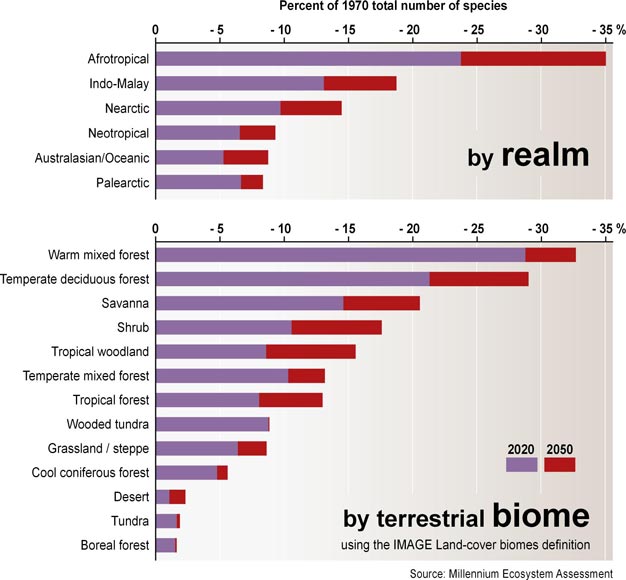
    Relative Loss of Biodiversity of Vascular Plants between 1970 and 2050 as a Result of Land Use Change for Different Biomes and Realms in the Order from Strength Scenario.
    Source: Greenfacts

    Thursday, July 26, 2007

    UNESCO launches biodiversity project for 4 heritage sites

    Read about the initiative in the Hindu News Update (India).

    UNESCO has identified four world heritage sites -- Kaziranga and Manas in Assam, Keoladeo in Rajasthan and Nanda Devi in Uttaranchal-- in India as role models to demonstrate conservation management practises for other biodiversity hotspots. The World Heritage Biodiversity Project was launched today by UNESCO for holistic development of these sites. The project is seen as critical to the preservation of globally significant biodiversity.