Wednesday, January 30, 2008

UNESCO and The Universal Declaration of Human Rights

Eleanor Roosevelt with a copy
of the Universal Declaration of
Human Rights


This year the United Nations, and indeed the whole world, are celebrating the 60th anniversary of the Universal Declaration of Human Rights.

The English Bill of Rights was passed in 1689. The French Declaration of the Rights of Man and the Citizen was adopted in 1789. The U.S. Bill of Rights was introduced as ten amendments to the Constitution in 1789 and ratified in 1791. Thus in three countries, political and civil rights were codified by the end of the 18th century. People were seen as having a right to participate in the governance of their nation, and to have natural rights that would be protected against the "divine rights" of kings and the aristocracy.

The social and economic rights of man took longer to recognize. However, with the increasing wealth of Western nations, people began to demand that all people in those nations had the rights to be free from hunger, that they shared with the rich the right to at least a basic education, and to some standard of care during their illness. In the Great Depression, the right to work, to a living wage, and to some form of social security for the young and old became evident, notably to the Government of the United States.

At the end of World War II, the United States was the world's super power militarily, economically, scientifically, culturally, and politically. The U.S. Government, serious in its concern to avoid the mistakes made after World War I, sought to establish with its allies a United Nations that would help to keep the peace. The United Nations would succeed where the League of Nations had failed. As the Bill of Rights was a needed complement to the U.S. Constitution, so the Universal Declaration of Human Rights would be a complement to the Charter of the United Nations.

The existence of the Universal Declaration is due in large part to the determination of non-governmental organizations (along with a number of smaller countries, particularly those from Latin America). A Pan-American conference held in Mexico City in February and March of 1945 consolidated Latin American determination to see human rights included in the UN Charter. Over 1,300 American non-governmental organizations joined together in placing newspaper ads calling for human rights to be an integral part of any future international organization. Individually and collectively, these advocates demanded that the United Nations Charter include a clear and substantive commitment to human rights.

Based on the recommendations of a commission chaired by Eleanor Roosevelt, the UN’s Economic and Social Council established the official UN Commission on Human Rights in June 1946. The Council selected eighteen members to sit on the Human Rights Commission. U.S. Delegate Eleanor Roosevelt was elected Chairperson. Her role was crucial. Not only was she the widow of Franklin Delano Roosevelt, credited with leading the United States out of the Depression and to victory in World War II -- with enormous prestige among the allied nations -- but she had acted often for him due to his disability and in her own right in the defense of human rights. Moreover, she was an exceptionally capable leader in bringing people with divergent views together to agree on that which they could share.

A number of organizations prepared inputs to the process of writing the Declaration. UNESCO, specifically, was asked to examine whether there were in fact universally recognized human rights. Were human rights recognized only in the traditions of Western culture, or were they also recognized in Asian, African, and Middle Eastern cultures. Indeed, there was a great divide among those who felt that there were natural rights established at the creation of man, and those who felt that rights accumulated through a historical process and that the rights of man in the late 1940's differed from those of the past, and from those that would be recognized in the future.

UNESCO created a distinguished committee in 1947 to consider the matter. They in turn invited intellectual leaders from all over the world to provide inputs describing human rights, and indicating the sources of those rights in the traditions of their own cultures. The committee sent forward a report to the United Nations setting forth the grounds for the Declaration, a report which was quite influential in the final creation of the Universal Declaration. Importantly, the committee recognized that people everywhere recognized a right to life and dignity, certain freedoms, and aspirations for rights to at least a minimum standard of life. Even when people could not agree on the philosophical basis from which those rights were derived, they agreed that those rights did exist and should be recognized by nations.

A book was published from the committee's work titled Human Rights: Comments and Interpretations: A Symposium Edited by UNESCO. The book included an introduction by Jacques Maritain, and included contributions by Mahatma Gandhi, Harold Laski, Pierre Teilhard de Chardin, Chung-Shu Lo, Aldous Huxley, and Ralph Gerard. It illustrated the power of UNESCO which could provide a forum for intellectual leaders from different continents and traditions to discuss intellectual issues of global importance, and find ways to reach agreement.

Maritain, who headed the French delegation to the Second General Conference of UNESCO, in his introduction to the book, wrote looking back at his speech to the General Conference:
"How", I asked, "can we imagine an agreement of minds between men who are gathered together precisely in order to accomplish a common intellectual task, men who come from different cultures and civilizations, but are of antagonistic spiritual associations and schools of thought...? Because, as I said at the beginning of my speech, the goal of UNESCO is a practical goal, agreement between minds can be reached spontaneously, not on the basis of common speculative ideas, but on common practical ideas, not on the affirmation of one and the same conception of the world, of man and of knowledge, but on the affirmation of a single body of beliefs for guidance in action. No doubt this is little enough but it is the last resort of intellectual agreement. It is, nevertheless, enough for a great task to be undertaken, and it would do much to crystallize this body of common practical convictions.
UNESCO continues to include human rights actions as a central part of its concerns, including through its:

Monday, January 21, 2008

Seminar on Scientific World Heritage Sites

A three-day international workshop, designed to develop guidelines to identify future World Heritage Sites which represent advances in science and technology of global significance, will be hosted next week by the Department for Culture, Media and Sport and the UK National Commission for UNESCO on behalf of the World Heritage Committee.

The workshop, taking place from 21-23 January, brings together experts from 15 countries, representing the physical sciences and technology as well as those with detailed knowledge of the operation of the UNESCO World Heritage Convention.

The delegates will discuss ways to create a scientific framework, to help identify and recognize sites which represent the heritage of science and technology that could potentially become World Heritage Sites. The conclusions of the expert meeting will be presented to the World Heritage Committee for consideration at their next meeting this July in Quebec, Canada.

1. The program for the workshop can be found on the UK National Commission for UNESCO website at http://www.unesco.org.uk/Science-Heritage-Meeting.htm.
2. There will be particular focus on four areas: astronomy, physical sciences, biological sciences and engineering and technology.
3. This workshop was organized at the UK's suggestion during the 31st session of the World Heritage Committee, held last July in Christchurch, New Zealand.
4. The outcome of this meeting will contribute to the development of guidelines for the identification of sites and a preliminary framework for the evaluation of properties of interest for the heritage of science and technology and their potential inscription on the World Heritage List. The recommendations of the Workshop will be submitted to the 32nd session of the World Heritage Committee. This session will be held from 2-10 July in Quebec, Canada.
5. The concept of World Heritage Sites is at the core of the World Heritage Convention, adopted by UNESCO in 1972, to which 184 nations belong. The Convention required the establishment of the World Heritage List, under the management of an inter-governmental World Heritage Committee, as a means of recognizing that some places, both natural and cultural, are of sufficient importance to be the responsibility of the international community as a whole. The UK ratified the World Heritage Convention in 1984.
Editorial Comment: Given American leadership during much of the last century in science and technology, I would think that the United States might proudly claim a number of such world heritage sites. How about Cape Canaveral, Edison's laboratory, the sites of the American System of Manufacturing, the University of Chicago site of the first nuclear reactor, a site linked to the invention of the Internet, etc. JAD

The World Science Forum

The World Science Forum (WSF) was created in 1999 at the World Science Conference. It serves as a forum on science for the nations of the world. the Forum met in Budapest, Hungary in 2003, 2005 and 2007, and is to meet again in 2009 on the tenth anniversary of the World Science Conference. Its website provides information on these meetings.

The WSF convened in Budapest November 8-10, 2007 with the overarching theme "Investing in Knowledge: Investing in the Future." Attracting more than 400 scientists from over 60 countries. They included government officials and representatives of NGOs.

The WSF is a joint event of the Hungarian Academy of Sciences, UNESCO and the International Council for Science. Its goal is to promote dialog and the exchange of ideas on key issues relevant to scientists and policymakers alike. The three-day program included sessions on "Science and Innovation as a Global Enterprise" (chaired by Dr. Alan Leshner in which both he and Dr. Arden Bement outlined the U.S. approaches to research funding in an increasingly interconnected global scientific environment."

Representing the United States at the 3rd Biennial World Science Forum (WSF) were Ambassador April H. Foley, the Director of the National Science Foundation, Dr. Arden Bement and the CEO of the American Association for the Advancement of Science (AAAS), Dr. Alan Leshner.

Two from Roger Coate


Roger Coate, a long time member of the Board of Directors of Americans for UNESCO has published two important articles in The Interdependent Winter 2007-2008 issue. The Interdependent is the flagship publication of the United Nations Association of the United States of America (UNA-USA).
  • Poverty Goals: The Possible, the Probable, the Unlikely
    The article points out that while the Millennium Development Goals are not likely to be met, their importance may not be so much in defining a specific development path as in creating a process by which the nations of the world focus on poverty and agree on means to combat it.

  • AID AND DEBT RELIEF: Development’s Bottom Line
    Coate shows that the donor community is lagging badly on its committments to provide financial assistance to developing nations. Moreover, that assistance is being focused on only a few countries, such as Iraq and Afghanistan. The lack of donor assistance, which is covered in MDG 8, is in part responsible for the shortfall in meeting the other Millennium Development Goals. So too is the international trade domain that does not allow developing nations equitable access to international markets. Coate notes that a bad as the failure to achieve the Millennium Development Goals might be, abandonment of the global effort to erradicate poverty would be much worse for the world.

Friday, January 18, 2008

International Year of Planet Earth

In late 2005, the General Assembly of the United Nations proclaimed 2008 as the International Year of Planet Earth. 2008 will be the central year in a Planet Earth triennium that will begin in January 2007 and end in December 2009. The implication of a UN proclamation is that all 191 UN nations have adopted the aims and ambitions of the IYPE and are willing to contribute to their implementation. Hence, this proclamation is the most ambitious scientific and outreach program ever designed in the geosciences, and provides an unprecedented opportunity to showcase to the world the relevance and socioeconomic importance of the Earth sciences.

This new international multidisciplinary Earth science initiative was conceived by the International Union of Geological Sciences (IUGS), which represents about 250,000 geoscientists from 117 countries. Planning for the IYPE began in 2000; twelve-organizations--IUGS, IUGG, IGU, AGI, INQUA, AAPG AAPG, ILP, IUSS, ISRIC, GSL, TNO, and AIPG -- were part of the initial effort to organize this special year for the Earth sciences and became Founding Partners.

They will share responsibility for activities in 2007-2009 with an IYPE Board of Officers and UNESCO.

Thursday, January 17, 2008

UNESCO World Press Freedom Prize 2008

UNESCO has invited Member States and regional and international organizations, professional and non-governmental organizations working in the field of journalism and freedom of expression to nominate candidates for the UNESCO/Guillermo Cano World Press Freedom Prize.

The purpose of the UNESCO/Guillermo Cano World Press Freedom Prize is “to honour… a person, organization or institution that has made a notable contribution to the defense and/or promotion of press freedom anywhere in the world, especially if this involved risk.”

The prize is intended to reward journalists who have shown dedication in the name of freedom of expression and information and to afford them the international recognition they deserve. Awarded annually, the Prize is marked by a ceremony and the winner is presented with the sum of US$25,000.

Nominations for the Prize should be submitted by 30 January 2008 to UNESCO, Division for Freedom of Expression, Democracy and Peace.


Russian reporter Anna Politkovskaya

Anna Politkovskaya, the late Russian journalist, was the laureate of the 2007 UNESCO/Guillermo Cano World Press Freedom Prize.
"Anna Politkovskaya showed incredible courage and stubbornness in chronicling events in Chechnya after the whole world had given up on that conflict. Her dedication and fearless pursuits of the truth set the highest benchmark of journalism, not only for Russia but for the rest of the world. Indeed, Anna's courage and commitment were so remarkable, that we decided, for the first time, to award the UNESCO/Guillermo Cano World Press Freedom Prize posthumously."

"Born in 1958, Ms Politkovskaya studied at the school of journalism of Moscow State University. She was a columnist for the Novaya Gazeta newspaper. An outspoken campaigner for human rights, Ms Politkovskaya was particularly well known for the hundreds of articles she published on the conflict in Chechnya. Her work was recognized nationally and internationally. She received the Golden Pen of Russia award, a Special Diploma of the Jury of the Andrei Sakharov Prize 'For the Life Sacrificed to Journalism"' and the Olof Palme Prize, to name but a few. She was killed in the entrance of her home in Moscow on October 7, 2006."

UNESCO designated lead agency for the International Year of Astronomy 2009


The United Nations has proclaimed 2009 the International Year of Astronomy (IYA 2009) and designated UNESCO as its lead agency. The International Astronomical Union (IAU) will act as implementing body.


Seminar: indicators for mapping and comparing national research systems

Where and how is research generated, transmitted, received and used in today’s knowledge society? These are fundamental questions that are being addressed at a symposium hosted by the UNESCO Forum for Higher Education, Research and Knowledge in Paris from 16 to18 January.

UNESCO and partners help teachers bring technology to the classroom

UNESCO initiated, in 2006, a project aimed at providing core standards for the integration of information and communication technology (ICT) into the classroom. Competency Standards for Teachers (CST) were launched on 8 January 2008 after two years of development, at the Moving Young Minds conference, an international seminar gathering 100 education ministers from around the world to discuss the role of technology in enhancing education.

  • ICT competency standards for teachers: policy framework
  • ICT competency standards for teachers: competency standards modules
  • ICT competency standards for teachers: implementation guidelines: version 1.0
  • UNESCO takes Mini-laboratories and Microscience to the Middle East

    For a decade now, UNESCO has been introducing the methodology for microscience into the education systems of both developed and developing countries. One of UNESCO’s key partners in this endeavour is the RADMASTE Centre, Witwatersrand University, South Africa. Training workshops in microscience have been organized in some 84 countries and recently, UNESCO has turned its attention to the Middle East.

    In collaboration with the Islamic Organization for Education, Science and Culture (ISESCO), UNESCO has introduced the microscience project into Jordan, Lebanon, the Palestinian Territories and Syria. As project coordinator at UNESCO, Maria Liouliou took part in the first training workshops in Beirut and Ramallah, in November 2006 and February 2007.


    The microscience methodology gives primary and secondary school pupils and university students alike an opportunity to conduct practical scientific experiments in physics, chemistry and biology using kits that come with a textbook. These kits are veritable mini-laboratories. They are perfectly safe, insofar as pupils never need to use more than a couple of drops of chemicals for each experiment. The kits are also affordable and far cheaper than conventional laboratory material. Each kit is compact, can be reused and is unbreakable because made of plastic. In addition, the small quantities of chemicals used make it environment-friendly.


    Monday, January 14, 2008

    USTTI Course Catelog Is Now Out

    Normally this blog focuses on information more directly relevant to UNESCO. We make an exception in announcing the new catalog for USTTI, because it provides such a great opportunity for people in developing nation National Commissions for UNESCO who are interested in communications and information. USTTI offers an affordable opportunity for people from developing countries to develop knowledge and skills about information and communications technologies though study in the United States.


    The United States Telecommunications Training Institute is a non-profit public-private partnership between senior federal officials and leaders of the U.S. information and communication technology (ICT) and broadcast industries. The goal of this collaborative effort is to share the United States' technological and managerial advances with women and men who regulate and maintain the IT and communications infrastructures throughout the developing world.

    I was involved in a formal evaluation of USTTI many years ago, and was greatly impressed by its programs, and the positive perception that they had in the minds not only of their sponsors and teachers, but also their graduates.

    In 2008, USTTI will offer 83 courses. Each of these courses is described in this 2008 course catalog. The catalog also includes information about how to apply, and funding. Since the courses are offered without tuition to developing country participants, and since in some cases funding for travel and living expenses in the United States is available, the courses are often quite affordable.

    A group of Indian Ocean emergency communications students from the U.S. Telecommunications Training Institute (USTTI) during a visit to the Pacific Tsunami Warning Center. They visited the Center other NOAA facilities in the Pacific and Alaska Regions to learn how the United States conducts tsunami preparedness and mitigation. UNESCO of course is sponsoring the development of tsunami warning systems through it Intergovernmental Oceanographic Program. Source: NOAA NWS Focus

    Sunday, January 13, 2008

    UNESCO's Natural Sciences Newsletters

    Through its newsletters, the UNESCO Natural Sciences Sector promotes its activities in science worldwide and provides a platform for the exchange of information among people and institutions around the world.

    A World of Science is UNESCO's quarterly science journal. It is published in January, April, July and October each year in English, French, Russian and Spanish.

    UNESCO Venice Newsletter
    is a quarterly newsletter published in English by the UNESCO Office Venice - UNESCO Regional Bureau for Science and Culture in Europe (BRESCE)

    News from the Biosphere World Network provides a regular overview of the new initiatives, events and publications related to the biosphere reserve activities and scientific achievements of the Man in the Biosphere (MAB) Program.

    Related links:
    :: Bangkok Office Newsletter
    :: Beijing Office Publications
    :: Currents: newsletter of the World Water Assessment Program (WWAP)
    :: Harmful Algae News
    :: Jakarta Newsletter
    :: Nairobi Office Newsletter
    :: News from ICTP
    :: Señal: Montevideo Office Newsletter
    :: UNESCO-Quito Newsletter
    :: Water Portal's Newsletter

    Science and technology for the well-being of all

    Within the framework of UNESCO's 60th anniversary celebrations, a 60 minute presentation on Science and Technology for Development highlighted the use of small technology and renewable energies in poverty reduction and sustainable development and presented an outstanding example in the Sahel.

    The Session was complied of an introduction was followed by the three presentations:
    • Small is Working by Tony Marjoram, responsible for engineering sciences in UNESCO's Basic and Engineering Sciences Division;
    • Renewable Energies for Sustainable Development by Osman Benchikh, responsible for energy and renewable energy in UNESCO's Basic and Engineering Sciences Division;
    • The Sahel project - an example of using science and technology for development by Ms Chifa Tekaya, responsible for coordinating the Cross-Cutting Theme programme on poverty reduction in UNESCO's Social and Human Sciences Sector.

    Friday, January 11, 2008

    UNESCO releases a user's guide to community radio

    “Community Radio: A user’s guide to the technology” is a guide to technical parameters of community radio in India. Produced for potential community radio operators, this technical manual takes into account the intention of the Government of India to establish 4000 community radio stations by 2008.

    The publication aims to accompany interested organizations in the demystification of each piece of equipment usually found in community radio stations, its role and function within a wider social context, advantages and disadvantages of its usage. For others, who dare to be technically more adventurous, detailed notes on equipment are also provided.

    Read the full Guide (PDF format)!

    Read the news release on the Guide.


    Editorial Comment: Why, you might ask, is this interesting to Americans? Well of course, we have a community radio movement in this country, and those broadcasters can use the guide too.

    More importantly, we depend on a world of informed people, and believe in freedom of information. For the speakers of the vast majority of the world's 6,000 living languages, radio and television broadcast things they can not understand. The community radio solves that problem, with the broadcaster serving as a gatekeeper between the local community and its language, and the larger national and international flow of news and intervention.

    UNESCO is the U.N. Agency that deals with communication and information, and it is important to us that it focuses on the community radio movement. With new, low cost, portable, easy to operate stations that movement is exploding in Africa and Asia, where it is most needed. JAD

    Tuesday, January 08, 2008

    UNESCO photo contest on The Changing Face of the Earth


    UNESCO’s International Geoscience Program (IGCP) is running a photo contest on the theme of The Changing Face of the Earth, to raise awareness among youth of the state of the planet. There are several cameras and 40 book prizes to be won. Entries close on 30 June 2008.

    Happy One-hundred Years, Unesco!

    LIEN / LINK, the journal of the former employees of UNESCO, has just published its 100th issue. Jacques Richardson has written an interesting article for the issue titled "Happy One-hundred Yeats, UNESCO." His abstract:
    Just as the world’s educational, scientific and cultural atmosphere helped shape Unesco’s programs during the 20th century, so would certain emergent factors help lend new form and dynamism to the Unesco of the first half of the 21st century and its future.

    Here is the story of how this happened.

    Ecosystems: acting for sustainable land-water-habitat management

    The variety of life on Earth is disappearing at an increasing rate. UNESCO's MAB Program is an intergovernmental initiative originally created to set up the scientific basis for improving people's relationships with nature, linking the natural and social sciences. In particular, MAB aims at increasing our understanding on the structure, functioning and dynamics of ecosystems and people's roles therein. Assessing global change impacts on ecosystems and promoting appropriate management of freshwater resources in these systems have become key issues in recent years for the MAB program.

    Click here for an overview of strategies and projects undertaken by UNESCO's Man and the Biosphere Program in a few significant ecosystems.

    UNESCO: A key actor in the fulfilment of the global biodiversity agenda

    "Biodiversity, the variety of life on Earth, is disappearing at an unprecedented and most likely increasing rate. This situation contradicts the international "2010 Biodiversity Target", which aims at significantly reducing the rate of biodiversity loss by 2010. Science and governance for conserving and sustainably and equitably using biodiversity are key elements to decrease the rate of its loss.

    Since its early days, UNESCO's Man and the Biosphere Program has initiated programmes and activities focusing on the diversity and the resources provided by nature, humans' impacts on biodiversity, as well as how biodiversity affects human activities. These initiatives are intended to contribute to the fulfillment of a global biodiversity agenda."


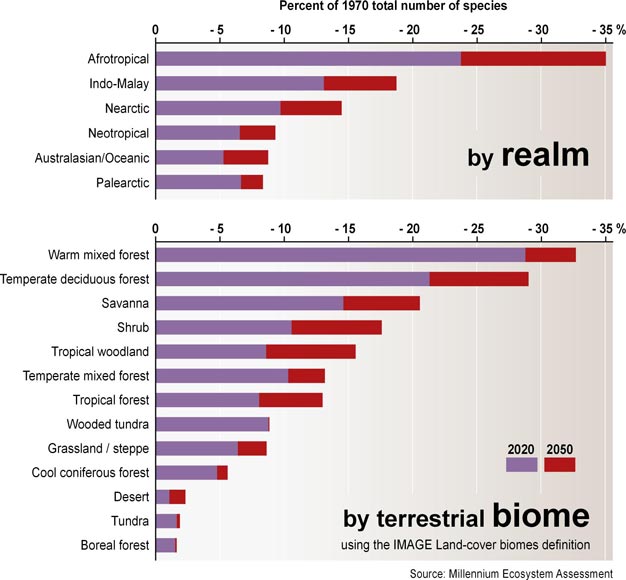
    Relative Loss of Biodiversity of Vascular Plants between 1970 and 2050 as a Result of Land Use Change for Different Biomes and Realms in the Order from Strength Scenario.
    Source: Greenfacts

    Sunday, January 06, 2008

    UNESCO Clubs distribute relief among cyclone victims

    The National Association of UNESCO Clubs in Bangladesh has been carrying out a relief operation in the cyclone-hit Jhalakathi district in cooperation with Korean National Federation of UNESCO Clubs and Associations recently.

    The clubs distributed food, baby food, utensils and old clothes to the affected people of Kathalia and sadar upazila of the district. Members of UNESCO Club of Bagerhat also distributed rice, water purifying tablet, oral saline, old clothes and utensils among the affected people of Morelganj upazilla.

    UNESCO has a network of thousands of clubs that spans the globe, although there are relatively few UNESCO clubs in the United States. Americans for UNESCO participates for the United States in the
    World Federation of UNESCO Clubs, Centers and Associations (WFUCA).

    What do you think about Americans for UNESCO taking a strong role in helping to create UNESCO clubs in the United States? American UNESCO clubs could take part in UNESCO's efforts, and could help their counterparts in developing nations as the Korean clubs have recently done in Bangladesh.

    Leave us a comment with your answer!

    Wednesday, January 02, 2008

    The UN declares 2009 the International Year of Astronomy


    The United Nations 62nd General Assembly has proclaimed 2009 the International Year of Astronomy. The Resolution was submitted by Italy, Galileo Galilei's home country. The International Year of Astronomy 2009 is an initiative of the International Astronomical Union and UNESCO.

    The International Year of Astronomy 2009 (IYA2009) celebrates the first astronomical use of the telescope by Galileo — a momentous event that initiated 400 years of astronomical discoveries and triggered a scientific revolution which profoundly affected our worldview.

    State Department Seeks Applications for a New U.S.-UNESCO Center

    People don't think much about hydrology until something goes wrong due to a failure of the science; dikes fail flooding a city or flooding out crops due to flood conditions greater than had been predicted, or ground water is polluted due to errors in understanding the flow of pollutants, or an aquifer runs dry, or civil engineering works such as roads or bridges are washed out.

    As important as hydrology is now, it is going to be even more important in the future. Climate change is going to change the availability of water resources. Population growth and movement, together with economic growth are going to increase demands on water resources -- probably to a degree that there will be chronic water shortages for many regions and many people in this century.

    UNESCO's Natural Science program is the lead program in the United Nations system for hydrology. Much of its efforts are conducted through a network of centers. Indeed, since most of these centers are Category II, not receiving resources from UNESCO directly, the International Hydrological Program is importantly a network of self-financed institutions located in countries around the world.

    The network of Category II water science centers is continuing to grow. The recent General Conference endorsed the establishment of the following (category II water science centers under the auspices of UNESCO:
    • Regional Centrefor Shared Aquifer Resources Management (Libyan Arab Jamahiriya);
    • International Groundwater Resources Assessment Centre (Netherlands);
    • Regional Centre for Water Management Research in Arid Zones (Pakistan);
    • International Centre on Hydroinformaticsfor Integrated Water Resources Management (Itaipú Binaciónal: Brazil–Paraguay);
    • Institute on a Partnership for Environmental Development (Italy).
    The establishment of an International Centre of Water for Food Security at Charles Sturt University (Australia) was approved in principle, the final decision on the terms of the agreement being delegated to the Executive Board.

    There is no Category II center in the United States of any kind, in part because the United States was not a member of UNESCO for so many years. Now however, the State Department has announced that it will accept applications for a U.S. water center that would perform theoretical and experimental research and advanced training, contribute to the execution of UNESCO's program, and increase the participation of national and regional institutions in UNESCO's efforts.

    Applications for IHP Category II centers are considered on a biennial basis. The deadline for applications is next week (January 8th). The applications will first be reviewed by the U.S. National Commission for UNESCO. Those which are endorsed by the Commission and the Government will be passed to UNESCO, where they will be be the subject of feasibility studies, and ultimately considered by the next General Conference.

    The U.S. National Committee for IHP has highlighted the following key aspects of the UNESCO IHP as priorities for U.S. collaboration:
    • Three focus areas: advocacy (of IHP programs and aims), research, and capacity-building
    • Three thematic areas: safe drinking water; global climate change; and water hazards
    • Support existing IHP programs: e.g. WWAP, PCCP, HELP, FRIEND, ISARM, IFI
    • Support UNESCO Category II Centers: Collaborate with existing Centers


    A diagram of the hydrological cycle.

    Science Tightens its Belts

    I quote from A World of Science (January-March 2008)
    The approved biennial budget amounts to US$631 million. Of this, US$20,857,600 (3.3%) is allocated to activities in Natural Sciences – US$1,015,000 of which will go directly to the Abdus Salam International Centre for Theoretical Physics. The budget envelope for staff costs in Natural Sciences amounts to US$35,416,700 (5.6%). The second (category 1) UNESCO science institute, the UNESCO-IHE Institute for Water Education, is funded exclusively from extrabudgetary resources.

    Within the first biennial priority for science, there is to be stronger coordination between the International Hydrological Programme, the UNESCO-IHE and other water-related centres, as well as with UNESCO Chairs. Biosphere reserves are to be used increasingly as learning platforms for sustainable development, including ecotourism, and for environmental management and monitoring. In tandem, UNESCO’s role in geosciences and in Earth observation is to be developed to monitor changes in land, water and oceans, and improve understanding of climate change and its impact. UNESCO will continue to foster a culture of disaster preparedness, including via implementation of the Global Tsunami Warning System.

    Within the second biennial priority for science, the programme will develop a culture of science education at all levels that is inclusive of girls; it will foster capacity-building in science, technology and innovation (STI) via collaboration with scientific networks, centres of excellence and NGOs, encouraging South–South and triangular North–South–South cooperation. Countries will continue to receive assistance and support in formulating and implementing STI policies. Access to knowledge and basic services via cutting-edge technologies will be promoted and energy policies for sustainable development devised.
    Editorial Note: Here are some tips for understanding UNESCO jargon.

    UNESCO receives funds from assessments of its member states, and from voluntary contributions which are termed "extrabudgetary resources". The extrabudgetary resources are almost as large as the regular budget for the organization as a whole.

    Category I centers receive funding from UNESCO, and there are relatively few of them. Category II centers are associated with UNESCO but do not receive money from the Organization.

    UNESCO continues to budget its staff costs separately from its program costs, which is part of the reason that only 3.3% of the regular budget is allocated to the Natural Sciences. Funds are separately allocated to the Human and Social Sciences. A relatively larger portion of total program funding comes from extrabudgetary rather than assessed contributions in the Natural Science program.

    Still, however, the amount of money allocated to the Natural Science program of UNESCO is very modest when compared to the global gross product allocated to research and development in the Natural Sciences, and the lack of resources severely constrains UNESCO's abilities to build science and technology capacity in developing nations.
    JAD

    Tuesday, January 01, 2008

    Israeli Science Feted at UNESCO

    Prof. Aaron Ciechanover lectures
    at the scientific conference.

    An event saluting the Israel's Technion and Israeli science took place in mid December at UNESCO headquarters in Paris, under the auspices of French President Nicholas Sarkozy, and with the participation of scientists from the Technion and France. The event was held to mark Israel’s 60th anniversary.

    At the scientific event, dozens of Israeli and French professors lectured before an audience numbering some 400 persons. At the festive reception in the evening, the Philharmonic Orchestra performed, conducted by two French academics – Jacques Attali and Daniel Cohen. The audience of some 1,200 was treated to an appearance by Nobel Prize Laurette, Prof. Aaron Ciechanover of the Technion’s Rappaport Faculty of Medicine.

    Read:

    Monday, December 31, 2007

    Happy New Year

    The new issue of A World of Science

    The January-March 2008 edition of UNESCO's A World of Science has just been published.

    The contents include:
    • Arctic sea ice a record low
    • Ocean observing flotilla hits 3000 mark
    • Report confirms science still dominated by men
    • Children follow in gorilla’s footsteps
    • 23 new biosphere reserves in countdown to Congress
    • Water institute to train 2100 iranians
    • Environment prized at Forum
    There is also an editorial by Walter Erdelen, Assistant Director-General for Natural Sciences

    Sunday, December 30, 2007

    Editorial: The Intergovernmental Oceanographic Commission

    The Intergovernmental Oceanographic Commission (IOC) "has a problem". It is being asked to take on more and more responsibilities, and in fact had a cut in its budget during the last biennium. The recent General Conference of UNESCO ordered the creation of a Working Group on the Future of the IOC. The United States was elected one of the ten members of the Working Group. The Working Group will meet on 19 and 20 February 2008 in UNESCO headquarters in Paris.

    A questionnaire has been circulated asking UNESCO's member states to provide information on their views on the IOC and the priorities for it for the future. The U.S. National Commission for UNESCO is holding a phone conference on January 7th seeking advice on the U.S. response to the questionnaire.

    I think most Americans don't recognize how important the oceans are to our civilization, nor how important is the role of the IOC in coordinating international scientific efforts to understand the oceans. We go to the beaches. Once and a while a disaster such as Hurricane Katrina or the Banda Ache Tsunami gains our attention. Americans fail to recognize the environmental challenges posed by loss of fisheries, degradation of coastal zones, or loss of tropical reefs. The energy crisis has directed attention to off shore drilling.

    Since most of the earths surface is ocean, the oceans have huge influence on the weather of our continent, and of all the continents. We will not understand climate change unless we understand the absorption of greenhouse gases by the oceans, and the interaction of the atmosphere and the oceans. Similarly, climate change is expected to have important implications for the oceans, including sea level rise, changes and increases in serious storms, and changes in ocean environments and thus biodiversity. These will in turn have important impacts on the large portion of the world's human population that lives close to the oceans.

    If one has any doubt about the economic and security importance of the ocean, just look at the United Nations Convention on the Law of the Seas. The Convention was the result of a decade of negotiations, and has not been ratified by the United States in the 25 years since it was signed. The Bush administration is now asking for Congressional ratification of the treaty.

    Mapping and studying oceans involves obtaining data on ocean systems that do not respect national borders. UNESCO and the IOC can legitimate research voyages and other data gathering techniques, making them acceptable to the nations whose waters are studied. UNESCO and the IOC can legitimate the findings of such research, demonstrating that they do not favor one or another party to a dispute among nations.

    If there were not an IOC, the world would have to create one. Fortunately, not only is the an IOC, but it has celebrated its 50th anniversary, and is well established as a legitimate intergovernmental scientific institution.

    The response to the questionnaire on the future of the IOC requires detailed knowledge beyond that which I possess. Having said that, it is important that the public gives its views on the broader issues involved in the IOC's operation and the solution of the IOC's problems. I suggest that:

    • There is increasing need for scientific understanding of the oceans and the ocean-land and ocean-atmosphere interfaces. The century of climate change faced by the world requires that such information be developed, but so does increasing degradation of ocean environments, increasing anthropogenic pressure on coastal and ocean environments and resources, and increasing need for resources from the oceans.
    • The issues of international ocean policy depend greatly on ocean science, but have broader economic and political aspects; scientific advice is necessary but not sufficient for defining U.S. policy toward UNESCO and the IOC.
    • It is very important not only that the United States' government coordinates with all stakeholders in U.S. ocean policy in formulating its positions on the IOC.
    • ..S/ policy toward the UNESCO's oceanographic activities and the IOC includes concerns for the ocean resources in our own coastal zones, the weather and ocean systems that directly affect our country, and our ocean commerce and shipping.
    • However, the United States as the world's richest and most powerful country has a responsibility to lead in assuring that oceanographic information is developed and made available to all nations, and that the legitimate interests of other nations in ocean science are respected and addressed by UNESCO and the IOC.
    • While there needs to be greater support for IOC programs and activities as they are extended to meet more and more pressing demands, that support should not be achieved by cuts in other critical UNESCO services in education, communications, peace, culture or indeed in other science programs. Thus, UNESCO's budget should grow in the future, given that it has continued success in increasing the efficiency with which it uses resources.
    • I strongly support the IOC and UNESCO's involvement in intergovernmental ocean science, and strongly urge the State Department to be forthcoming in the negotiations about the future of the IOC.
    The opinions expressed above are mine and do not necessarily represent those of Americans for UNESCO or any other group.

    John Daly

    Thursday, December 20, 2007

    UNESCO and HP Sign Strategic Partnership Agreement


    UNESCO and Hewlett-Packard (HP) signed a strategic partnership agreement on 19 December to strengthen their collaboration around existing education projects. The signing ceremony, held at UNESCO’s headquarters in Paris, was attended by Koïchiro Matsuura, UNESCO Director-General and Gabriele Zedlmayer, vice president, Global Citizenship HP Europe, Middle East and Africa (EMEA).

    Through the partnership, UNESCO and HP will work together on several projects in the area of education, especially to support UNESCO’s priority of “Education for All". This includes an evaluation on the extension of the existing brain drain project to additional regions in Europe, the Middle East and Africa. UNESCO and HP started to collaborate five years ago in South East Europe to help key universities connect to global research networks. In 2006 the project was extended to Africa. The project fights brain drain by providing universities with an advanced technology called grid computing, which allows top quality researchers to play a key role in international research and contribute to economic development in their home countries.

    Another project is the World Heritage Map, which enables the general public to visualize the spread of World Heritage sites around the globe, and raises the awareness of the World Heritage Convention. The map is above all an educational tool, allowing UNESCO to communicate its work in this field on a large scale.

    In addition HP has provided a financial contribution to UNESCO for the “Printing and distribution of the Man and the Biosphere Map”. The Man and the Biosphere Map will be fully prepared and edited by the Division of Ecological and Earth Sciences of UNESCO, which will provide the full lay-out to HP for printing and distribution.

    The Computer recycling training guide is also the fruit of UNESCO and HP cooperation: it aims to support local stakeholders, in developing countries in particular, to manage electronic waste. The goal is to support local actors, especially those with a background in managing used computer equipment, and to create environmentally clean and healthy business opportunities. HP is the only technology partner in the project, which also includes the French Agency for Environment and Energy Management (Agence de l'Environnement et de la Maîtrise de l'Energie - ADEME), EMMAUS, the international movement of solidarity, and TIC ETHIC, Information and Communication Technologies in the service of ethics and sustainable development.

    Forging innovations: Community Multimedia Centres in Nepal


    Forging innovations: Community Multimedia Centers in Nepal


    This collection of case studies on the Community Multimedia Centres (CMCs) in Nepal is intended to showcase the interesting and diverse growth of this initiative in spite of conflict and the lack of community radio regulation in the country.

    The publication introduces the CMCs and outlines the benefits and challenges that the centers have faced since they were established. Each CMC is discussed in four parts: location and context, organizational structure, programs and sustainability. The case studies show how local communities access and utilise newly available ICT tools in different ways.

    In 2003 UNESCO supported the creation of Nepal's first pilot CMC in Tansen, Palpa. Since then, the Organisation has assisted in the creation of two additional CMCs in Nepal, one in Madanphokhara (Palpa District) and another in Lumbini (Rupandehi District). The three CMCs are now networked to five telecentres throughout Rupandehi and Palpa Districts.

    The CMC media mix in Nepal consists of FM broadcasting services, cable TV network, design and desktop publishing software applications, audio and video editing, and public access points for Internet, telephone, fax, photocopiers and scanners.

    In an effort to understand the social impact of CMCs the authors, Karma Tshering and Kirsty Martin, carried out field visits to the centers. They interviewed managers, staff, local researchers, community reporters, volunteers and community people. Unobtrusive observations of the centres were conducted to gain a sense of the normal daily activities.

    By examining three centers concurrently, common themes emerged in the overall functionality of CMCs in Nepal. This study identifies some key issues which can assist CMCs towards their goal of providing ICT access to poor and marginalised communities in regional Nepal

    Monday, December 17, 2007

    Athelstan Spilhaus: First U.S. Ambassador to UNESCO

    The new highlight on the website of Americans for UNESCO begins a series on the pioneers in the creation of the organization and on the establishment of linkages between the United States and UNESCO.

    The first person to be profiled is Athelstan Spilhaus, a distinguished scientist, inventor, educator, and popularizer of science who was the first U.S. Ambassador to UNESCO and who served on its Executive Board. Late in his life, when he accurately described himself as a "retired genius", he established a world class collection of more than 3,000 mechanical toys.

    UNESCO BPI Memos

    The Bureau of Public Information of UNESCO publishes a series of memos, called Memobpi. Here are links to a few of them:

    Peacebuilding
    A commitment to peace implies a way of resolving conflicts, not according to the force of might, but by respecting internationally accepted norms, the rule of law and negotiation, with the aim of achieving a fullness of life for each and every one. By its Constitution, UNESCO is called upon to “build the defenses of peace in the minds of men.”
    Science and Technology for Development
    The overall focus of science, engineering and technology program activity at UNESCO is on human and institutional capacity building

    Virtual Conferencing
    Planning a virtual conference is rather like planning a journey: before traveling you need to make choices about when and how to travel (by plane, car, train …) based on available time, funds, weight of luggage, etc. Likewise, when planning a virtual meeting, you need to maketheproperchoices…

    Wednesday, December 12, 2007

    Review of UNESCO’s Capacity-Building Function

    A review was completed last February or UNESCO’s experience in capacity building and of the international research on capacity building to answer the following questions:
    1. What have UNESCO and others learned about the most effective approaches to capacity building?
    2. What should UNESCO’s role in capacity building be (given UN reforms that emphasize country-led, comprehensive development strategies and collaboration among donor agencies)?
    3. What needs to change within UNESCO in order to do a better job of capacity building?
    The purpose of this review was to inform UNESCO's senior management about good practices in capacity-building and to enable UNESCO's Secretariat to improve their capacity-building interventions.

    A key finding of the review was:
    Most UNESCO staff members interviewed recognize that capacity building needs to get beyond conventional inputs, such as training and technical assistance, in order to bring about sustainable change within institutions. However, much of the Organization’s programming begins and ends there.

    Mondialogo Engineering Award Symposium


    Mondialogo, a partnership between UNESCO and DaimlerChrysler, works to bring young people together to foster meaningful dialogue and exchange between cultures and civilizations. One major pillar is the Mondialogo Engineering Award, of which two rounds have been held so far.

    Participants are young engineers and engineering students from developing and developed countries who have cooperated in mixed teams to develop project proposals which can contribute to the achievement of the Millennium Development Goals, particularly those of poverty eradication and sustainable development, in developing countries.

    In June 2007, for the second time, an international jury of prominent scientists selected the top thirty-one nominees, out of 92 participating teams. Ten of these top teams will receive cash prizes of €20,000 each for the initiation of their projects, and twenty of whom will receive honourable mention and €5,000 each in prize money.

    The prizes were awarded during the Mondialogo Engineering Award Ceremony & Symposium which will take place in Mumbai, India from 7-10 December 2007.

    Tuesday, December 11, 2007

    Global Change in Mountain Regions

    ©T. Schaaf, Yosemite Nat. Park, USA

    Global Change in Mountain Regions (GLOCHAMORE): A world-wide network to study global change processes in mountains has been in operation since October 2003. It is based on some 25 mountain biosphere reserves in all continents that serve as monitoring and study sites. A research strategy has been worked out to:

    * detect signals of global change
    * identify the consequences
    * suggest responses at local and regional scales

    Among the more than 100 scientists and bioreserve managers are a number of Americans:
    • Baron, Jill. Dr., Natural Resource Ecology Laboratory, Colorado State University
    • Bowman, William. Dr., University of Colorado INSTAAR
    • Bradley, Raymond S. Prof., Department of Geosciences, University of Massachusetts
    • Fagre, Daniel B. Dr., Ecologist/Global Change Research Coordinator, USGS Northern Rocky Mountain Science Center
    • Graumlich, Lisa. Prof., Big Sky Institute
    • Hansen, Andrew J. Prof. Dr., Montana State University - Bozeman, Department of Ecology
    • Hardy, Douglas. Dr., Department of Geosciences, University of Massachusetts
    • Kang, Sinkyu. Dr., Numerical Terradynamics Simulation Group, School of Forestry University of Montana
    • Malanson, George P. Dr., Department of Geography, University of Iowa
    • Millar, Constance I. Dr., PSW Research Station, Albany
    • Nechodom, Mark. Dr., Sierra Nevada Research Center - Pacific Southwest Research Station, Forest Service, United States Department of Agriculture (USDA)
    • Porter, Charles. Dr., Director of Patagonia Research Foundation, Maine
    • Taylor, John. Dr. Head, Argonne Regional Climate Center, Illinois
    Editor's note: The song you are trying to remember is "How are things in Glocca Mora" from the musical Finnian's Rainbow. I remember because Harry Stockwell, who I knew as a child, was in the road company. JAD.

    UNESCO at GK3 in Kuala Lumpur: Towards building knowledge societies


    The Global Knowledge Partnership's GK3 is a unique gathering of 2,000 global visionaries, innovators, practitioners and policy makers, all geared to sharing knowledge and building partnerships on a platform created by and for stakeholders from every sector - private companies, governments, international institutions and civil society groups.

    UNESCO is participating
    actively in the Third Global Knowledge Conference (GK3) from 11 to 13 December 2007 and in its parallel events and exhibits. UNESCO has set up an onsite Community Multimedia Centre (CMC) and an exhibition promoting the concept of CMC in building knowledge societies at the Kuala Lumpur Conventional Center.


    Here are a couple of videos from GK3:

    Robotics program from the Omar Dengo Foundation in Costa Rica

    i4d film festival: Viirtual village

    Monday, December 10, 2007

    The Office of Director General of UNESCO

    Luther H. Evans
    The only U.S. citizen to be
    elected Director General

    The Director General is the chief executive officer of UNESCO. The DG's term of office is four years (previously six years), and the Director General is elected by the General Conference. The current Director General, Koïchiro Matsuura, has been in office since 1999. He was reelected to that post by the 33rd General Conference of UNESCO in 2005. Thus there is some speculation as the election of his successor in 2009.

    There have been nine Directors General since UNESCO was founded in 1946:
    • Koïchiro Matsuura from Asia
    • Four from Europe: Federico Mayor (1987 - 1999), René Maheu (1962 - 1974; acting 1959, 1961-1962), Vittorino Veronese (1958 - 1961), and Julian Huxley (1946 - 1948)
    • Amadou-Mahtar M'Bow from Africa
    • Three from North America: Luther Evans (1953 - 1958). John W. Taylor (Acting DG 1952 - 1953), and Jaime Torres Bodet (1948 - 1952)
    The position of Director General of UNESCO is an important one within the system of intergovernmental organizations. Therefore the election of a new Director General is the subject not only of electioneering by individual candidates, but also diplomatic negotiations among member nations.

    There is an informal understanding that the post should rotate among the (193) member nations of UNESCO, and indeed among continents and groups of nations. Moreover, there are informal understandings about the need to distribute leadership of UN family organizations among nations. (The situation is somewhat different in international financial institutions, programs of the United Nations such as the UNDP, UNICEF and UNFPA, and organizations with their own general assemblies such as UNESCO, WHO, and FAO.)

    The Islamic nations, which form a large cultural block with significant voting power in United Nations bodies, may see their opportunity in the next General Conference to elect one of their citizens to the post of Director General. You can be sure that State Department diplomats are already debating possible candidates and consulting with their counterparts in other delegations to UNESCO.

    Sunday, December 09, 2007

    Two Foreign Policy Experts Recommend Smart Power

    Reference: "Stop Getting Mad, America. Get Smart." By Richard L. Armitage and Joseph S. Nye Jr., The Washington Post Sunday Outlook, December 9, 2007.

    Richard L. Armitage was deputy secretary of state from 2001 to 2005. Joseph S. Nye Jr., a former assistant secretary of defense, teaches political science at Harvard. They co-chaired the Center for Strategic and International Studies' Commission on Smart Power.

    They write:
    The world is dissatisfied with American leadership. Shocked and frightened after 9/11, we put forward an angry face to the globe, not one that reflected the more traditional American values of hope and optimism, tolerance and opportunity. This fearful approach has hurt the United States' ability to bring allies to its cause, but it is not too late to change. The nation should embrace a smarter strategy that blends our "hard" and "soft" power -- our ability to attract and persuade, as well as our ability to use economic and military might......the United States needs a broader, more balanced approach (than it has been employing).....

    when our words do not match our actions, we demean our character and moral standing. We cannot lecture others about democracy while we back dictators. We cannot denounce torture and waterboarding in other countries and condone it at home. We cannot allow Cuba's Guantanamo Bay or Iraq's Abu Ghraib to become the symbols of American power.......

    In a changing world, the United States should become a smarter power by once again investing in the global good -- by providing things that people and governments want but cannot attain without U.S. leadership. By complementing U.S. military and economic strength with greater investments in soft power, Washington can build the framework to tackle tough global challenges. We call this smart power.

    Smart power is not about getting the world to like us. It is about developing a strategy that balances our hard (coercive) power with our soft (attractive) power. During the Cold War, the United States deterred Soviet aggression through investments in hard power. But as Gates noted late last month, U.S. leaders also realized that "the nature of the conflict required us to develop key capabilities and institutions -- many of them non-military." So the United States used its soft power to rebuild Europe and Japan and to establish the norms and institutions that became the core of the international order for the past half-century. The Cold War ended under a barrage of hammers on the Berlin Wall rather than a barrage of artillery across the Fulda Gap precisely because of this integrated approach.

    Specifically, the United States should renew its focus on five critical areas:
    • We should reinvigorate the alliances, partnerships and institutions that allow us to address numerous hazards at once without having to build a consensus from scratch to respond to every new challenge.
    • We should create a Cabinet-level voice for global development to help Washington develop a more unified and integrated aid program that aligns U.S. interests with the aspirations of people worldwide, starting with global health.
    • We should reinvest in public diplomacy within the government and establish a nonprofit institution outside of it to build people-to-people ties, including doubling the annual appropriation to the Fulbright program.
    • We should sustain our engagement with the global economy by negotiating a "free trade core" of countries in the World Trade Organization willing to move directly to free trade on a global basis, and expand the benefits of free trade to include those left behind at home and abroad.
    • We should take the lead in addressing climate change and energy insecurity by investing more in technology and innovation.
    Editorial Comment. This is a very important recommendation. If the next administration decides to adopt a "smart power" policy, UNESCO should be a key instrument of that policy. No organization is better placed on which to build a consortium of like minded nations, and to practice public diplomacy that listens as well as lectures! JAD

    Saturday, December 08, 2007

    UNESCO's Internal Oversight Service


    UNESCO's Internal Oversight Service (IOS), established in 2001, provides consolidated oversight covering internal audit, evaluation, investigation and other management support to strengthen the functioning of the Organization. The IOS website provides links to recent evaluations, as well as guidance for evaluations, and links to evaluation resources.

    Some examples are:

    UNESCO's 21st Century Talks


    The 21st-Century Talks are forums for prospective reflection and future oriented debate that gather together leading figures from different regions of the world. Together with the UNESCO's World Reports they form UNESCO’s Foresight and Anticipation Program.

    The Talks are used as the basis for books, articles in leading newspapers and academic journals of different regions of the world, and production of radio and television programs.

    Over the period 1999-2005, 27 “21st Century Talks and Dialogs” were organised. There were 118 speeches by 95 different speakers in the series. The three “Dialogues” gathered more speakers (particularly in Seoul with 23 speakers) than the “Talks” with only three or four. “Talks” were organised at UNESCO Headquarters in Paris, Barcelona, Durban and Seoul.

    As a result of the program, three books – and a total of 21 translated versions - were published.
    There is specific information on many of the talks available from the UNESCO website.

    An evaluation of UNESCO's Foresight program was published in 2006.
    The evaluation report notes:
    The activities of the Foresight and Anticipation Program had major support from UNESCO Member States. The “21st Century Talks and Dialogs” are viewed as having dealt with crucial issues for the future which were debated by a highly competent and diverse set of specialists who contributed highly relevant analyses. Member State representatives appreciated the foresight effort made by UNESCO. There is general agreement that Foresight and Anticipation are major missions of UNESCO.

    Thursday, December 06, 2007

    A Historical Note: UNESCO and the Universal Declaration of Human Rights

    One of the first tasks the United Nations assigned to its Human Rights Commission (chaired by Eleanor Roosevelt) was the preparation of what was then referred to as an “international bill of rights.” The Commission was to produce a set of common standards that would serve as a kind of yardstick by which all countries could measure their own and each others’ progress toward making human rights a reality.

    At that time, in 1945, no one really knew whether there were any rights with a plausible claim to acceptance in all the cultures of the world, or, if so, what they might be. "To examine those questions, UNESCO appointed a committee of philosophers, including some, such as Jacques Maritain and Benedetto Croce, who were prominent in the West, and others who belonged to Confucian, Hindu, and Muslim traditions. The philosophers in turn sent a questionnaire to other leading thinkers all over the world—from Mahatma Gandhi to Teilhard de Chardin. In due course, the Committee reported that, somewhat to their surprise, the responses they received indicated that there were a number of principles of basic decency that were widely shared—though not always formulated in the language of rights. Gandhi, for example, recommended framing a bill of duties. The Committee’s report, the questionnaire, and several responses are collected in Human Rights: Comments and Interpretations (United Nations Educational, Scientific and Cultural Organization ed., 1949)."

    The book went through several editions, and appears to have been quite influential, being cited in many other works. As the Universal Declaration celebrates its 60th anniversary, the book is still available through used book dealers.

    Source: Mary Ann Glendon, "The Forgotten Crucible: The Latin American Influence on the Universal Human Rights Idea," Harvard Human Rights Journal, Volume 16, Spring 2003.


    Eleanor Roosevelt holding
    a copy of the Universal Declaration

    Human Rights Day, December 10, 2007

    Mrs Eleanor Roosevelt of the United States holding a Universal Declaration of Human Rights poster © UN Photo

    Human Rights Day
    10 December 2007


    UNESCO launches a year-long commemoration of the 60th anniversary of the Universal Declaration of Human Rights on Human Rights Day.

    On Human Rights Day, 10 December 2007, at its Headquarters in Paris, UNESCO will unveil the list of activities commemorating the 60th anniversary of signing the Universal Declaration of Human Rights.

    > More …
    > UNESCO and Human Rights
    > More on the Declaration of Human Rights

    Wednesday, December 05, 2007

    International Migrants Day

    It is estimated that some 200 million people live outside of their home countries. And this is not a new phenomenon: Europe, America, and Australia were all built on the influx of millions of people in search of a better life. Since 2000, the international community has designated the 18th of December as International Migrants Day, to celebrate the achievements and highlight the struggles of migrants around the world.

    Last year the international advocacy and resource center on the human rights of migrant workers launched Radio 1812, a global radio event. In that event community stations, commercial radios and national and international broadcasters in over twenty countries produced and broadcast on one day more than 50 programs in languages from Chinese and Thai to Spanish and Kazak.

    This year, supported by UNESCO and the International Organization of the Francophonie, amongst others, Radio 1812 is back hoping to bring together more radios, more migrants and more concerned citizens to take part in the celebrations on the 18th of December 2007.

    60th anniversary of the Universal Declaration of Human Rights

    © UNESCO/Ivaldo Alves
    Brasilia


    Celebrations for the 60th anniversary of the Universal Declaration of Human Rights will be launched at UNESCO on 10 December, Human Rights Day. Events commemorating the anniversary will take place over the next year, until 10 December 2008.


    The 60th anniversary provides an opportunity to mobilize the whole of the United Nations and to evaluate progress in respecting and promoting human rights. UNESCO will take this opportunity to assess the situation of rights in its fields of competence. UNESCO is planning two international conferences on the subject in 2008: one on human rights education, the other on human rights in the Organization’s other fields of competence. In addition, the 61st International Conference of non-governmental organizations (NGOs) which will be organized at UNESCO in September 2008, in partnership with the United Nations Department of Public Information, will focus on the celebration of the Universal Declaration’s 60th anniversary.

    The Magic Planet

    As a reminder of the importance of outreach and education in enhancing S&T goals, Ambassador Oliver invited the developers of the Magic Planet digital video globe - Global Imagination - to display a portable version of the globe and associated control panel at a reception held by the Permanent Delegation of the United States to UNESCO. The reception was held in conjunction with the General Conference. A larger version of the Magic Planet was used by NOAA and NASA presenters during the Planet Earth: Space to Place exhibit at UNESCO during the Conference. In a hands-on mode, many of the reception’s guests were able change display global datasets ranging from water temperature to population shifts. In an example of public-private-partnership, the U.S. National Commission for UNESCO worked closely with Global Imagination on the presentation.

    Here is a short video of Magic Planet.

    The World Press Freedom Prize 2008


    UNESCO invites Member States and regional and international organizations, professional and non-governmental organizations working in the field of journalism and freedom of expression to nominate candidates for the UNESCO/Guillermo Cano World Press Freedom Prize.

    The purpose of the UNESCO/Guillermo Cano World Press Freedom Prize is “to honour… a person, organization or institution that has made a notable contribution to the defense and/or promotion of press freedom anywhere in the world, especially if this involved risk.”

    The prize is named after the Colombian journalist who died exercising his profession and has become a symbol of the fight against repression of the media worldwide.

    The UNESCO Chair of Mathematics and Economics at Colombia University

    Graciela Chichilnisky holds the UNESCO Chair of Mathematics and Economics. She is also a Professor of Statistics at Columbia University and the Director of Columbia’s Center for Risk Management (CCRM). She created Columbia’s Program on Information and Resources (PIR), which is focused on transforming the University’s teaching and research agenda to reflect the growing trend towards globalization and sustainable development. Since 1995, the PIR program attracted major support from the United Nations Educational, Scientific and Cultural Organization (UNESCO) from six leading reinsurance companies and the Sloan Foundation.

    According to the Washington Post:
    Nobel laureates laud her work and call her brilliant; some economists credit her with an important economic theory. She is involved in the economics of fighting global warming internationally, and she was recently elected to the university senate.....

    She has two doctorates, in math and economics. It is a combination that allows her to mix social science with hard sciences, according to other economists.

    Her work involves issues affecting sustainable development around the world, and she is a key contributor to the economic theory behind the movement to use credits in global markets to control carbon emissions to reduce global warming.

    She has taught at several universities, including Harvard, and served as adviser to many international organizations, including the U.N. Economic Commission for Latin America and the Caribbean, the Organization for Economic Cooperation and Development, and the United Nations in the areas of international economics and environmental policy.

    10 December 2005 - Human Rights Day


    Human Rights Day is observed every year on 10 December to mark the anniversary of the adoption by the United Nations General Assembly of the Universal Declaration of Human Rights in 1948.