Wednesday, February 27, 2013

DfID and AusAID reviews of UNESCO and responses.


UNESCO has published some facts and figures on the Organization's reforms. The graph above is from that publication. It shows the budget for UNESCO by biennium (the 36th biennium is 2012 and 2013). The graph shows the considerable reduction in the current biennium, in part due to the United States withholding its assessed contributions to UNESCO.

The Department for International Development (DfID) of the United Kingdom did a multilateral aid review in 2011. It is currently updating that review. Here is a page with the 2011 judgments for UNESCO. UNESCO has provided an update on its operations for the 2013 exercise.

Similarly, the Australian AID organization (AusAID) developed scorecards for multilateral organizations in 2012. Here is the scorecard for UNESCO. Here are UNESCO's comments on the scorecard.

The Courier on the Human Rights


Stéphane Hessel died on Feb 27. Click here for UNESCO Director General Bokova's tribute to Ambassador Hessel.

He helped edit the Universal Declaration of Human Rights, adopted by the United Nations in 1948. Hessel, in an article in the UNESCO Courier in 2008, explained how the document is unique and why it must remain universal – but also why it might not be adopted today. 

UNESCO published an issue of The Courier in 1968, the International Year for Human Rights, devoted to the topic.

Thursday, February 21, 2013

A Civics Lesson: Restoring funding to UNESCO.

The United States is withholding funds from UNESCO since the Organization's General Conference voted to allow Palestine membership. It is doing so because of provisions of the Foreign Relations and Intercourse Authorization passed in 1990 and 1994.

In order to restore funding
  • The authorization law will have to be changed either to eliminate the provisions or to allow the President to waive them if he finds doing so to be in the national interest. In the latter case, the president would have to issue a waiver in the specific case of UNESCO.
  • Funds would have to be included for UNESCO in the foreign affairs appropriations.
Last year the Obama administration requested the waiver authority and it has also requested the appropriation of funds for UNESCO.

The authorization legislation defines policy -- what the program is to do. It is the province of:
  • The Senate Committee on Foreign Relations and
  • The House of Representatives Committee on Foreign Affairs.
The appropriations legislation is the province of:
  • The House of Representatives Committee on Appropriations and
  • The Senate Committee on Appropriations,
The 113th Congress convened in January 2013. The response to the administration's requests will depend on the members of this session. In the Senate key committee members are likely to be:

In the House of Representatives the key committee members are likely to be:
  • Kay Granger, Republican, chairwoman of the relevant subcommittee of the Appropriations committee
  • Nita Lowey, Democrat, ranking member of that subcommittee and ranking member of the Appropruations committee itself. She is a strong supporter of Israel.
  • Harold Rogers, Republican, chairman of the Appropriations committee
  • Christopher Smith, Republican, chairman of the relevant subcommittee of the Foreign Affairs committee
  • Karen Bass, Democrat, ranking member of that subcommittee
  • Ed Royce, Republican, chairman of the Foreign Affairs committee
  • Eliot Engel, Democrat, ranking member of the Foreign Affairs committee

The Senate, with a Democratic majority, is likely to be more responsive to the Obama administration's requests; the House, with a Republican majority, is likely to be less responsive. The last session of hte Congress was marked by contentious debates and gridlock. It remains to be seen how this session will evolve.

The economic priorities of this Congress should be:

  • in the short term, to create jobs and prevent an immediate return to recession
  • in the medium term to reduce the federal deficit and improve the debt to GDP ratio
  • in the long term to invest in education, technology and infrastructure to promote long term growth.
The foreign policy priorities of the U.S. government are generally to protect the security of the United States and to promote its economy internationally. The immediate concerns will probably be the Middle East and Asia.

It seems probable that in these circumstances there will be a tendency to press for reductions in expenditures on international organizations, including UNESCO. 

The immediate concern of the Congress will be to deal with "sequestration" and the "fiscal cliff". The willingness of the members to compromise now may give some indication of their willingness to compromise during the rest of this year's legislative agenda.

In terms of the broad range of issues before the United States government, funding for UNESCO seems likely to be of low priority. The issues of Israeli policy, peace between Israel, Palestine, and their neighbor countries, and U.S. participation in international organizations will probably be seen as more urgent, and the UNESCO funding issue will probably be resolved in terms of these related issues. Still, there are a number of people working very hard to restore U.S. funding to UNESCO and they may be successful. Restoration of funding to UNESCO before the General Conference this fall is necessary to assure that the U.S. vote will be retained, and this may give some urgency to Congressional action.

Friday, February 08, 2013

Update on the previous post


Here are a couple of articles relating to the last post:

  1. "Leading Senator Calls for Change in Self-Defeating US Policy on UNESCO", UN Dispatch, February 8, 2013
  2. "Obama’s budget’s surprise: Restore UNESCO funding!The Washington Post, 02/16/2012
Recall that the executive branch makes a budget request, but it is the Congress that actually appropriates funds. The House of Representatives has a major role, and the Obama administration may face an uphill battle getting funding for UNESCO. Last year it also requested funding for UNESCO, and it was not appropriated.

In terms of foreign policy, I agree with Senator Leahy that U.S. funding for UNESCO enables it to do more to achieve our objectives than would an alternative use of the funds. I don't think that restoration of funding to UNESCO would significantly damage our relations with Israel, and it might help a little with opinion about the USA in the Arab and Islamic worlds.

In terms of domestic policy, the lobby that pushed through the 1990 legislation still exists and will probably oppose any change in that legislation.

Thursday, February 07, 2013

Senator Leahy supports U.S. renewal of funding for UNESCO


I just received an email with the following:


Statement of Senator Patrick Leahy

On

The Rescue and Reconstruction of Cultural Antiquities in Timbuktu

United States Senate Floor

February 7, 2013

Mr. LEAHY.  Mr. President, there was a lot of attention recently on the French military’s operation to repel Islamic extremists and Tuareg nationalist rebels who had terrorized the local population of northern Mali, including in the ancient city of Timbuktu.  That operation was widely welcomed by local Malian citizens and the international community.  Many of the rebels are believed to be hiding out among the local population until the French soldiers leave, so whether they are ultimately vanquished remains to be seen.  It will depend in large measure on the longer term capability of a multinational force of African troops supported by the United States and others.

Besides terrorizing, torturing, mutilating, and slaughtering innocent people, the rebels destroyed ancient tombs, shrines, and manuscripts dating to a period many centuries ago when Timbuktu was a crossroads for commerce and a center of intellectual pursuits in northern Africa.  I mention this not only to inform those who may be unaware of Mali’s ongoing cultural importance, but also to call attention to the fact that Irina Bokova, director general of the United Nations Educational, Scientific, and Cultural Organization, commonly known as UNESCO, has already pledged to reconstruct the damaged mausoleums.  As she was quoted in The New York Times on February 4, 2013, “This is the record of the golden ages of the Malian empire.  If you let this disappear, it would be a crime against humanity.”

There are also little known heroes in this otherwise humanitarian and cultural disaster.  Malian residents, particularly Ali Iman Ben Essayouti, who knew the importance of priceless manuscripts preserved in a library funded by international donors including the Library of Congress and Department of State, managed to carefully move some of them to another location where the rebels did not find them.  As a result, although the rebels burned the library, only a small portion of the manuscripts were destroyed.

The other point of this is that, as many Senators are aware, the United States, once the largest contributor to UNESCO including under President George W. Bush, was forced to sever its support last year due to a 1990s law that prohibits U.S. funding to any United Nations-affiliated agency in which the Palestinian Liberation Organization (PLO) obtains the same standing as a member state.  After UNESCO’s members voted, against the advice of Ms. Bokova, to grant the PLO that standing, the law was triggered and U.S. funding abruptly ended.

This is illogical and self-defeating.  First, although the PLO was a terrorist organization in the 1990s, it is no longer.  Second, by cutting off our contribution to UNESCO we not only empower its other members, including Russia, Iran, and Syria, we also make it impossible to assist the organization in the kind of cultural preservation activities it is now undertaking in Mali, which are clearly in the national interest of the United States.  There are many other examples, including World Heritage Sites like the Great Barrier Reef, which UNESCO designates and protects, today without the support of the United States.  And finally, if U.S. funding is not restored before the end of this fiscal year, we will lose our vote in the organization.  Ironically, despite PLO membership in UNESCO, Israel has paid its dues through 2014.  Presumably, Israeli officials recognize, as we should, that their interests are far better served by participating in a UN agency, not by watching from the sidelines.

Mr. President, regardless of what one may think about Palestinian President Abbas’ effort to obtain UN membership for the PLO, and I am among those who regard it as an unhelpful distraction, cutting off U.S. funding to UNESCO and thereby weakening our influence and empowering our adversaries makes no sense.  It is time we recognize that a law that might have seemed sensible to some people years ago has had unintended consequences that run directly counter to our interests, and should be amended or repealed.

Our closest relatives are in danger and UNESCO is responding to their need

Great Ape Moment :BLISS, A six-day-old baby orangutan snuggles up.
Picture by EPA/ROLAND WEIHRAUCH
The Great Apes Survival Partnership (GRASP) was established in 2001. It aims to conserve the great apes (chimpanzees, gorillas and orangutans) and their habitat — primarily forested tropical ecosystems that provide important services to humanity, through pro-poor conservation and sustainable development strategies.

Friday, January 18, 2013

IOC/UNESCO: Addressing Nutrient Over-Enrichment


I recently had the pleasure of spending the New Year in the Pacific Northwest.  During my time there, I traveled along the Pacific coast just south of the Canadian border.  In a region renowned for natural beauty, the rocky shores didn’t disappoint.  Mile after mile of conifers edged waters that looked cold, calm, and clear.


It’s hard to imagine that waters like these could be anything but healthy.  But marine ecologist Dr. Joan Kleypas of the National Center for Atmospheric Research notes that changing CO2 levels are already impacting the shellfish industry in the Pacific Northwest.  “This is not a problem in the far distant future,” Kleypas warns.  “This is a problem now.”

In addition to rising CO2 levels, marine environments at large have seen substantial increases in nutrients such as phosphorous and nitrogen.  This uptick in nutrients can be traced in part to human activities such as food production, fossil fuel burning, and wastewater generation from people and industries alike.   In coastal waters, skyrocketing levels of nutrients are leading to ecosystem responses like eutrophication – think dense blooms of phytoplankton – and the ensuing chaos of depleted oxygen levels, i.e., hypoxia.  These changes in the tiny and unseen end in visible damage; the resulting low-oxygen “dead zones” cannot support most marine life.  Five hundred of these hypoxic dead zones have been identified globally already.  Although the world’s oceans are vast, the collective dead zones already cover a total global surface area roughly the size of the United Kingdom.  From sea-grasses to fish, marine ecosystems lose their overall resilience, and human activities that rely on coastal and marine health – fishing, tourism, etc. – suffer as well. 

In order to protect coastal areas, scientific partners have been working to address the root causes of this nutrient over-enrichment.  Earlier this month, an examination of nutrient/ecosystem dynamics was published in Biogeosciences, an interactive open-access journal of the European Geosciences Union.  The Intergovernmental Oceanographic Commission of UNESCO (IOC/UNESCO) was an executing partner for this project, coordinated by the United Nations Environment Programme (UNEP).  The paper may be found here.

Tuesday, January 15, 2013

Two New Publications from the UIS


Source: "A Snapshot of R&D Expenditure", UNESCO Institute for Statistics

Source: "Regional density of researchers and their field of employment". UNESCO Institute for Statistics

The UNESCO Institute for Statistics is perhaps the lead organization in the United Nations system for statistics on education, science and culture. Its most important impact may have been helping UNESCO to improve data collection by governments around the world in these fields. As a result of UNESCO's work, these data provide a more accurate comparison of what is happening among countries.

UIS has produced two new fact sheets on science:


Friday, January 11, 2013

A World of Science shines spotlight on water politics


In the latest issue of A World of Science, a group of experts on water politics provide an overview of the issues likely to dominate the International Year of Water Cooperation beginning in January, of which UNESCO is lead UN agency. The authors explain that arid climates are no more conflict-prone than humid ones, and that conflicts over water erupt in equal measure in rich and poor countries, democracies and autocracies, fortunately on rare occasions: over the past 70 years, incidences of cooperation have actually outnumbered conflicts by two to one.


A second story highlights some of the marvels of human ingenuity inscribed in the Memory of the World Register, to.mark the 20th anniversary of  UNESCO’s eponymous program.

We learn from a third article that, in less than 50 years, countries bordering the Mediterranean Sea have nearly tripled their demand for natural resources. Today, all 24 countries are ecological debtors. These findings were revealed on 1 October by Global Footprint Network, at a regional meeting in Venice (Italy) organized jointly with UNESCO. UNESCO’s Venice office plans to encourage Southeast European countries to introduce the ecological footprint concept into school curricula, in order to help prepare pupils for their future role as responsible, active citizens.

On 30 November, synthetic biology was one of the themes discussed at a forum organized jointly by UNESCO’s Social and Human Sciences Sector and the French NGO Vivagora at UNESCO headquarters in Paris. Synthetic biologists, who borrow techniques from engineering to create entirely new life forms, are currently operating in a regulatory vacuum. In an interview, Eric Hoffman from the NGO Friends of the Earth confirms that products containing synthetic organisms are already on the market. He also highlights the risk of some engineered life forms – including viruses – ‘escaping’ from the lab to contaminate other species.

Among the news stories, the developed countries have agreed to double funding for biodiversity protection and Australia has just created the world’s largest marine protected area. Meanwhile, Nigeria is establishing an international biotech institute that will function under the auspices of UNESCO and Teri University in India is to host a UNESCO chair on climate science and policy.


Home page and free subscription: www.unesco.org/en/a-world-of-science
Correspondence s.schneegans@unesco.org

Sunday, December 09, 2012

Human Rights Day 2012

On the occasion of the Human Rights Day 2012, UNESCO's Director-General Irina Bokova and the Mayor of the City of Bilbao Mr Iñaki Azkuna will award the UNESCO/Bilbao Prize for the Promotion of a Culture of Human Rights to Archbishop Emeritus Desmond Tutu from South Africa. Read more!

Saturday, December 01, 2012

Take Action Now To Assure The USA Funding for UNESCO

This is an update on a recent post.

The United States Government has withheld its funding from UNESCO since last year. It is now time to take action to encourage the government to fund UNESCO again. Write your Senator and Congressman. Sign this petition.

The Problem

Two parts of U.S. law are of specific concern (US Code - Title 22: Foreign Relations and Intercourse / 22 USC 287 - Sec. 287e. Authorization of appropriations; payment of expenses) :
  • Pub. L. 101-246, title IV, Sec. 414, Feb. 16, 1990, 104 Stat. 70: "(a) Prohibition. - No funds authorized to be appropriated by this Act or any other Act shall be available for the United Nations or any specialized agency thereof which accords the Palestine Liberation Organization the same standing as member states." (b) Transfer or Reprogramming. - Funds subject to the prohibition contained in subsection (a) which would be available for the United Nations or any specialized agency thereof (but for that prohibition) are authorized to remain available until expended and may be reprogrammed or transferred to any other account of the Department of State or the Agency for International Development to carry out the general purposes for which such funds were authorized." 
  • Pub. L. 103-236, title IV, Sec. 410, Apr. 30, 1994, 108 Stat. 454: "The United States shall not make any voluntary or assessed contribution - "(1) to any affiliated organization of the United Nations which grants full membership as a state to any organization or group that does not have the internationally recognized attributes of statehood, or "(2) to the United Nations, if the United Nations grants full membership as a state in the United Nations to any organization or group that does not have the internationally recognized attributes of statehood, during any period in which such membership is effective."
The General Conference of UNESCO last year admitted Palestine to membership. The United States Government immediately began to withhold payments of assessed and voluntary contributions to the Organization. UNESCO's rules state that the voting privileges of a member state will be revoked if it does not pay its assessed contributions for two years. The General Conference next year will approve the program and budget for UNESCO for the following two years and elect the Director General for the next four years.

The Remedy

The law should be revised to permit the President to waive these provisions if he decides it is in the interests of the United States to do so.

Why the Law Should Be Changed

There are a number of reasons that the law should be changed:
  1. It no longer achieves its original purpose. These provisions were included in the Foreign Relations Authorizations to prevent Palestine from being admitted to membership in United Nations organizations. Last year, in full knowledge of the law, the UNESCO General Conference admitted Palestine. Last week, also in full knowledge of the law, the United Nations General Assembly recognized Palestine as a state by admitting is to Non-Member State Observer status. Palestine has announced that it will apply for membership in other UN organizations and experts predict that the applications will be approved.
  2. The provisions as they stand are outdated. They became law in 1990 and 1994. At the time the Soviet Union had broken up, and the United States was exceptionally powerful in world affairs. The world has changed. Other countries and coalitions are more influential in United Nations venues. The Israeli-Palestinian conflict is two decades older and views about its possible solutions have changed. Most other nations have recognized Palestine as a state.
  3. The effects of the provisions may become profoundly contrary to U.S. national interests. If for example the United States were forced to withhold funding from the United Nations, the International Monetary Fund, or the World Health Organization by these provisions, especially at times of national security crisis, the national interest could suffer significant damage -- far more than would occur due to admission of Palestine as one of hundreds of members of such an organization.
  4. The provisions are unclear as written. What is the difference in meaning between "the same standing as member states" and "full membership as a state". Does granting of Permanent Observer Status to a state trigger the provision? (Palestine was just granted Non-Member State Permanent Observer status to the United Nations. Indeed, Palestine has long been granted a standing invitation to participate as observer in the sessions and the work of the General Assembly and is maintaining permanent offices at Headquarters.)
  5. The interpretation of "the full attributes of statehood" is also subject to uncertainty. (Belarus was admitted to membership in UNESCO in 1954 although at that time it was a constituent republic of the USSR. The United States Government at the time is reported to have argued that if the constituent republics of the USSR were to be admitted as member states, then the states of the USA ought also to be admitted individually.) And perhaps most importantly
  6. The provisions may take the decision on participation in an organization out of the hands of the U.S. government. Not only is it possible for a coalition of foreign nations to elect Palestine to membership in another UN organization, but it might be possible for a single state to make that case that a current member state of an international organization has characteristics that trigger the provisions.
The waiver would of course not delete the power of the Congress to delete funding of any UN family organization from appropriations bills. It would provide the possibility of the U.S. government responding more rapidly to events within the UN system than could the Congress in revision of legislation.

Why the Law Should Be Changes Now

The Administration believes that UNESCO's programs promote U.S. values and interests, and that it is in the national interest to contribute to UNESCO. (So do I.) If the United States does not pay its assessed contributions to UNESCO before the General Conference in October 2013, then it will not be able to vote at that General Conference. Perhaps more important, the voice of the United States will be less influential in UNESCO forums. UNESCO is the main United Nations defending important American values such as Freedom of the Press, equality of educational opportunities for girls, and education that promotes peace and opposes racism. Unfortunately, not all other nations share these values and it is important that the U.S. has a strong voice at UNESCO to defend those values.

Perhaps more important, now that the provision has failed in one venue it will soon be tested in others and may also fail in them. The President should now have the power to act quickly in the national interest in such circumstances.

The Process to Change the Law

There will probably not be a specific vote of the Congress on the proposed amendment. Rather it will be included in a larger bill to appropriate funds, that will probably be approved before March, 2013. Apparently the administration informs the Congress before such bills are voted that even if approved in the Congress, the President will not sign them into law unless they include certain provisions. If the waiver authority is included in the list of required provisions, lacking strong opposition in the Congress, the waiver will probably be incorporated into the bill.

What to do now

I would suggest that you use your social media to tell your friends to support this amendment to the law.

Contact your Representative in the House of Representatives and your Senator and explain your support for this amendment. If you can, explain why UNESCO is important in your state and in your district. Is there a world heritage site there, a geopark, or a bioreserve that benefits from UNESCO networking. If you live in an area at risk of earthquakes or tsumanis, explain why UNESCO's geology and tsumami warning systems matter to your community. If you live in a place in which there are water shortages or subsidence due to depletion of aquifers, explain why UNESCO's hydrology program is important to your community.

Alternatively, if you feel deeply about girls education, explain why UNESCO's program in that field is important to you. If you feel that it is important that people around the world know about the Holocaust, explain why UNESCO's Holocaust education program is critically important. If you are concerned with the loss of biodiversity, or if you love to visit world heritage sites around the world, explain that you value these programs of UNESCO.

Finally sign the petition of the Better World Campaign telling the administration to support UNESCO. You can do so by clicking here!

Sustainable Development in Coastal Regions and Small Islands

Flooded homes in Tuckerton, N.J., on Oct. 30 after Hurricane Sandy 

Hurricane Sandy recently provided a vivid demonstration of the vulnerability of U.S. coastal regions and islands to destruction and environmental degradation, as did Hurricane Katrina a few years ago. We recall that the United States has not only long coastlines with the Atlantic, Caribbean and Pacific, with many offshore islands, but also includes Hawaii and Puerto Rico. 

CSI is a global platform provided by UNESCO for environmentally sound, socially equitable, culturally respectful and economically viable development in coastal regions and small islands.


The CSI platform for intersectoral action was initiated in 1996. The following three complementary and mutually reinforcing approaches have been adopted:
  1. Field-based projects which provide a framework for collaborative action on the ground
  2. UNESCO Chairs and University Twinning (UNITWIN) arrangements, which support and enhance the field project activities through training, capacity building and awareness raising
  3. A multi-lingual, internet-based forum on 'Wise Coastal Practices for Sustainable Human Development'
Half a dozen field projects continue to operate worldwide. Three university chairs in sustainable coastal development have been formally established. The internet-based discussion forum includes some 19,000 recipients from around the world representing a wide range of specializations and interests. The field projects, backed-up by the UNESCO chairs and twinning networks, have developed and tested wise practices applicable to sustainable development of small islands and coastal regions. These practices provide guidance as to what can wisely be done under the prevailing circumstances.


Via the CSI platform, wise coastal practices for sustainable human development are exchanged, the voices of small islands amplified, indigenous knowledge mobilised for equitable resource governance, and youth given a say.

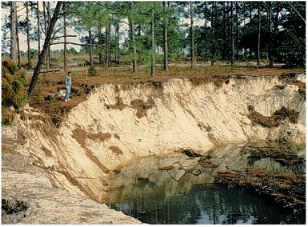
A USGS and UNESCO Joint Publication

Development of a new irrigation well in west-central Florida triggered
hundreds of sinkholes over a 20-acre area. The sinkholes ranged
in size from less than 1 foot to more than 150 feet in diameter.
Land subsidence due to the depletion of groundwater is a problem in many parts of the United States. The subsidence, when it occurs, breaks water mains and sewer lines, disrupts underground telephone cables, and collapses roads. It can even endanger buildings. The problem costs many millions of dollars per year, straining the budgets of many municipalities.

The Guidebook was originally Published in 1984 by Unesco as one of the contributions to the International Hydrological Program. Although the IHP is a scientific and educational program, Unesco has been aware of the need to direct its activities toward the practical solutions of the world's water resources problems. The Guidebook was intended as one of the tools to help provide for a multidisciplinary approach to the assessment, planning, and rational management of water resources.

Written in 1984, the Guidebook provides an overview of case studies illustrating the major occurrences of land subsidence due to ground-water withdrawal throughout the world at the time of its publication. But probably it's most enduring contributions are the chapters on field measurement of deformation and the mechanics of land subsidence. These chapters provide a basic understanding of subsidence that is valuable for both resource managers and scientists.

The Guidebook has enjoyed enduring demand. It has long since been out of print, but now is available in electronic form. Click here to download Guidebook.zip, an 11 MB compressed file in Winzip format. Interested in only a part of the document? Check out the PDF files available here.

UNESCO Associated Libraries in the USA

U.S. libraries advancing programs that cut across at least three of UNESCO’s five sectors (education, natural science, social science, culture, and communication/information) may apply for recognition as a UNESCO Associated Library by the U.S. National Commission for UNESCO.

Recognition through the UNESCO Associated Library program conveys to visitors and patrons that your library has a commitment to international engagement through communication, culture, education, and science. Libraries that receive this distinction may publicize their status as a UNESCO Associated Library and are eligible to display a special certificate issued by the U.S. National Commission for UNESCO. Moreover, becoming a UNESCO Associated Library enables an institution to tap into the network of UNESCO Associated Libraries in the U.S. and around the globe.

Any U.S. Library interested in recognition as a UNESCO Associated Library should complete and submit an application, which can be found here.

For an informational brochure, click here.

Statement by U.S. Ambassador David Killion to the 190th Executive Board

From the statement as delivered on October 8, 2012:
The United States remains a full and active members of the Organization.  President Obama is committed, and I am committed, to working with the U.S. Congress to seek a solution that would resolve the U.S. funding situation at UNESCO and restore our ability to pay our dues. 
 Read the full statement.

Tuesday, November 27, 2012

Take Action Now To Assure The USA Funding for UNESCO

The United States Government has withheld its funding from UNESCO since last year. It is now time to take action to encourage the government to fund UNESCO again. Write your Senator and Congressman. Sign this petition.

The Problem

Two parts of U.S. law are of specific concern (US Code - Title 22: Foreign Relations and Intercourse / 22 USC 287 - Sec. 287e. Authorization of appropriations; payment of expenses) :
  • Pub. L. 101-246, title IV, Sec. 414, Feb. 16, 1990, 104 Stat. 70: "(a) Prohibition. - No funds authorized to be appropriated by this Act or any other Act shall be available for the United Nations or any specialized agency thereof which accords the Palestine Liberation Organization the same standing as member states." (b) Transfer or Reprogramming. - Funds subject to the prohibition contained in subsection (a) which would be available for the United Nations or any specialized agency thereof (but for that prohibition) are authorized to remain available until expended and may be reprogrammed or transferred to any other account of the Department of State or the Agency for International Development to carry out the general purposes for which such funds were authorized." 
  • Pub. L. 103-236, title IV, Sec. 410, Apr. 30, 1994, 108 Stat. 454: "The United States shall not make any voluntary or assessed contribution - "(1) to any affiliated organization of the United Nations which grants full membership as a state to any organization or group that does not have the internationally recognized attributes of statehood, or "(2) to the United Nations, if the United Nations grants full membership as a state in the United Nations to any organization or group that does not have the internationally recognized attributes of statehood, during any period in which such membership is effective."
The General Conference of UNESCO last year admitted Palestine to membership. The United States Government immediately began to withhold payments of assessed and voluntary contributions to the Organization. UNESCO's rules state that the voting privileges of a member state will be revoked if it does not pay its assessed contributions for two years. The General Conference next year will approve the program and budget for UNESCO for the following two years and elect the Director General for the next four years.

The Remedy

The law should be revised to permit the President to waive these provisions if he decides it is in the interests of the United States to do so.

Why the Law Should Be Changed

There are a number of reasons that the law should be changed:
  1. It no longer achieves its original purpose. These provisions were included in the Foreign Relations Authorizations to prevent Palestine from being admitted to membership in United Nations organizations. Last year, in full knowledge of the law, the UNESCO General Conference admitted Palestine. Palestine has announced that it will apply for membership in other UN organizations and experts predict that the applications will be approved.
  2. The provisions as they stand are outdated. They became law in 1990 and 1994. At the time the Soviet Union had broken up, and the United States was exceptionally powerful in world affairs. The world has changed. Other countries and coalitions are more influential in United Nations venues. The Israeli-Palestinian conflict is two decades older and views about its possible solutions have changed.
  3. The effects of the provisions may become profoundly contrary to U.S. national interests. If for example the United States were forced to withhold funding from the United Nations, the International Monetary Fund, or the World Health Organization by these provisions, especially at times of national security crisis, the national interest could suffer significant damage -- far more than would occur due to admission of Palestine as one of hundreds of members of such an organization.
  4. The provisions are unclear as written. What is the difference in meaning between "the same standing as member states" and "full membership as a state". Does granting of Permanent Observer Status to a state trigger the provision? (Palestine has applied for Permanent Observer status to the United Nations. Indeed, Palestine has been granted a standing invitation to participate as observer in the sessions and the work of the General Assembly and is maintaining permanent offices at Headquarters.)
  5. The interpretation of "the full attributes of statehood" is also subject to uncertainty. (Belarus was admitted to membership in UNESCO in 1954 although at that time it was a constituent republic of the USSR. The United States Government at the time is reported to have argued that if the constituent republics of the USSR were to be admitted as member states, then the states of the USA ought also to be admitted individually.) And perhaps most importantly
  6. The provisions may take the decision on participation in an organization out of the hands of the U.S. government. Not only is it possible for a coalition of foreign nations to elect Palestine to membership in another UN organization, but it might be possible for a single state to make that case that a current member state of an international organization has characteristics that trigger the provisions.
The waiver would of course not delete the power of the Congress to delete funding of any UN family organization from appropriations bills. It would provide the possibility of the U.S. government responding more rapidly to events within the UN system than could the Congress in revision of legislation.

Why the Law Should Be Changes Now

The Administration believes that UNESCO's programs promote U.S. values and interests, and that it is in the national interest to contribute to UNESCO. (So do I.) If the United States does not pay its assessed contributions to UNESCO before the General Conference in October 2013, then it will not be able to vote at that General Conference. Perhaps more important, the voice of the United States will be less influential in UNESCO forums. UNESCO is the main United Nations defending important American values such as Freedom of the Press, equality of educational opportunities for girls, and education that promotes peace and opposes racism. Unfortunately, not all other nations share these values and it is important that the U.S. has a strong voice at UNESCO to defend those values.

Perhaps more important, now that the provision has failed in one venue, it will soon be tested in others and may also fail in them. The President should now have the power to act quickly in the national interest in such circumstances.

The Process to Change the Law

There will probably not be a specific vote of the Congress on the proposed amendment. Rather it will be included in a larger bill to appropriate funds,that will probably be approved before March, 2013. Apparently the administration informs the Congress before such bills are voted that even if approved in the Congress, the President will not sign them into law unless they include certain provisions. If the waiver authority is included in the list of required provisions, lacking strong opposition in the Congress, the waiver will probably be incorporated into the bill.

What to do now

I would suggest that you use your social media to tell your friends to support this amendment to the law.

Contact your Representative in the House of Representatives and your Senator and explain your support for this amendment. If you can, explain why UNESCO is important in your state and in your district. Is there a world heritage site there, a geopark, or a bioreserve that benefits from UNESCO networking. If you live in an area at risk of earthquakes or tsumanis, explain why UNESCO's geology and tsumami warning systems matter to your community. If you live in a place in which there are water shortages or subsidence due to depletion of aquifers, explain why UNESCO's hydrology program is important to your community.

Alternatively, if you feel deeply about girls education, explain why UNESCO's program in that field is important to you. If you feel that it is important that people around the world know about the Holocaust, explain why UNESCO's Holocaust education program is critically important. If you are concerned with the loss of biodiversity, or if you love to visit world heritage sites around the world, explain that you value these programs of UNESCO.

Finally sign the petition of the Better World Campaign telling the administration to support UNESCO. You can do so by clicking here!

Monday, November 26, 2012

Rutgers' International Institute for Peace: a UNESCO Category II Institute

The International Institute for Peace at Rutgers University (IIP) was approved last year to become the second UNESCO Category II institute in the United States.

The IIP was co-founded in May 2011 by Forest Whitaker, Goodwill Ambassador for Peace and Reconciliation, and Aldo Civico, a Rutgers University anthropologist and expert in conflict resolution. The IIP’s activities are wide-ranging: it will offer graduate-level degrees in Conflict Resolution and Peace Studies, promote research on cutting-edge issues relating to peace-building, and participate in real-life mediations of communities in conflict. Further, the IIP brings a unique expertise in addressing the violent conflicts that take place in cities, particularly among youth and gangs. Harnessing the talents and experience of filmmaker Forest Whitaker, the Institute will also seek to document conflict all over the world, providing people with an outlet to share their own stories of conflict and peace. The resulting documentaries shall raise awareness and, hopefully, instigate change.

From the signing ceremony in Paris.
Forest Whitaker, Ambassador David Killion, UNESCO Director General Irina Bokova and  Aldo Civico