Thursday, April 30, 2009

A Call for Restoration of Support for UNESCO


Bryan Gould, the chair of the New Zealand National Commission for UNESCO, has published an opinion piece in The Guardian (UK) on the occasion of the current meeting of UNESCO's Executive Board. I quote:
Step forward UNESCO. The oldest UN agency, during the era of economic man, has been pushed to the sidelines. Its emphasis on education, on the physical, human and social sciences, on culture and language, on the sustainable use of natural resources, as the mainsprings of human development and wellbeing, has seemed quaintly old-fashioned in an era of aggressive profit-seeking. But a restatement of those goals and values is now overdue. We can now assert, amid the wreckage created by economic man, that we are more than economic agents, and that Unesco's preoccupations point the way to a more complete and empowering sense of where our future lies.....

There are.......better ways of spending our money......Our focus should be on strategically planned programs for education in countries where schooling is still at a premium, in the strengthening of cultural identities to give people confidence to understand who they are and how they can play a constructive role in the world, in projects to protect and develop sustainable supplies of fresh water.....

UNESCO has never been funded to undertake these activities itself. Its current budget is pathetically small, and – in the current crisis – likely to get smaller. But, with proper financing, UNESCO could provide the intellectual leadership and strategic direction to ensure that skills and capabilities that are at present scattered and fragmented across the globe can be linked and co-ordinated, so that we get the maximum benefit from what we already have. UNESCO's role is to help us to do better than merely learn what not to do. Agencies like UNESCO can help us move forward by providing outcomes that are greater than the sum of their parts.

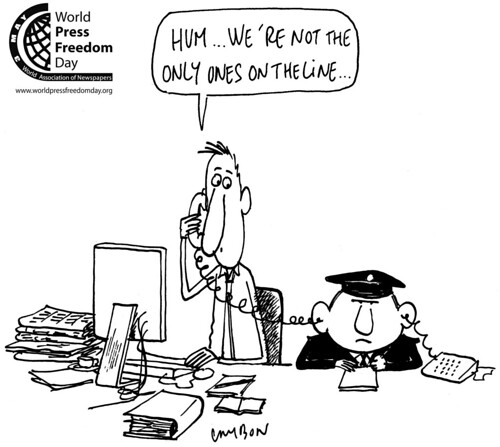
World Press Freedom Day 2009

UNESCO is organizing World Press Freedom Day celebration, from 2 to 3 May 2009 in Doha, the capital of Qatar. It will focus on the potential of media in fostering dialogue, mutual understanding and reconciliation.

The international conference will gather prominent media professionals and representatives of major non-governmental organizations from different parts of the world. This year, UNESCO invites participants to explore the enormous potential of media to serve as a platform for dialogue and a vehicle for understanding.

Tuesday, April 28, 2009

Clubs for UNESCO: a practical guide

Clubs for UNESCO: a practical guide, published in 2009 is a manual for those interested in starting or managing a UNESCO club. There are nearly 4,000 UNESCO clubs worldwide, but very few in the United States. The manual is an attractive 33 page brochure in PDF format.

World Heritage Scholarships in U.S. National Parks

Anasazi site, Mesa Verde National Park. NPS Photo


The U.S. National Park Service (NPS) is offering fellowships to qualified candidates who wish to learn from the U.S. experience in managing and protecting World Heritage Sites. All expenses paid extended residencies in U.S. parks designated as World Heritage Sites will be available to site managers and staff of World Heritage Sites in developing nations.

The training opportunity will allow selected individuals to work alongside NPS professionals in a variety of areas including resource management, concessions, interpretation and education, planning, and law enforcement. The NPS Office of International Affairs, in cooperation with park partners, will pay for and arrange for travel to the US, while individual host parks will provide housing and a modest living stipend.

The NPS has considerable experience in international training. Every year, more than one hundred individuals from all over the world volunteer in America's National Parks. The International Volunteers-in-Parks Program (IVIP) benefits both the individual volunteer and the National Park Service (NPS).

Perhaps the most famous sites which are both World Heritage sites and U.S. National Parks such as Yosemite and Yellowstone are best known as natural heritage sites. However, there are also important cultural World Heritage sites managed by the NPS such as Mesa Verde, the Statue of Liberty and Philidelphia's Independence Hall.

Fellowship candidates should be English speakers willing to spend a minimum of 6 weeks in the US. Residencies; up to 4 months can be arranged. The NPS Office of International Affairs will assist each selected individual in securing the appropriate visa to allow entry to the United States.

For more information, you may contact the responsible NPS officers:

Human Rights Pledges of the United States

On March 31, U.S. Secretary of State Hillary Rodham Clinton and U.S. Permanent Representative to the U.N. Ambassador Susan Rice announced that the United States will seek a seat this year on the United Nations Human Rights Council with the goal of working to make it a more effective body to promote and protect human rights.

As part of the process that will culminate in elections on May 12, each candidate country is asked to produce a pledge outlining its commitment to promoting human rights. This information is circulated among countries and posted on the UN Human Rights Council website. The United States has produced its pledge - Human Rights Commitments and Pledges of the United States of America.

Monday, April 27, 2009

Be In the Know: UNESCO Publication Plan Alert


Always feeling like the last to know about UNESCO publications? You're not alone. Yet for those seeking to stay current, UNESCO has made it easy to receive immediate notification about the upcoming and current UNESCO publications that are most of interest.


The UNESCDOC Publication Plan lets you subscribe to information updates for the publications about the areas or countries of interest . You can set how frequent you'd like the updates and which updates you'd like to receive. I just registered, and it was extremely user-friendly:


Sunday, April 26, 2009

On the Election of the Director General

When she addressed the UNESCO Executive Board in March of 2008, Ambassador Oliver mentioned this year's election of a new Director General for UNESCO, including the following:
I’d like to end my remarks by mentioning the most important issue facing UNESCO and the U.S. in the immediate future, which is of course the election of a new Director-General at the General Conference in October 2009. This will be the first time in 27 years that the U.S. will be engaged in the election process.

The selection of a new Director-General is critical for the organization, not only because that individual gets to choose his or her cabinet and the senior staff, but also because approximately one-third of UNESCO’s staff will reach the mandatory retirement age in the next five years. Moreover, since the U.S. has no veto at UNESCO, it is of the utmost importance for us that a new Director-General who is supportive of active U.S. engagement at that organization be selected.

The Chairman of the Executive Board is supposed to send a letter to all the delegations in June outlining the D-G selection process that took place last time. The process will be discussed at the October Executive Board, after which the Executive Board will send out a formal letter inviting individuals to apply for the position.

What makes this election process a bit awkward is that several candidates have already been actively campaigning for months. It is also unfortunate that although the U.S. really needs to play a major role in this process, both the State Department and the Mission will be facing significant changes in personnel and leadership. We must make sure that despite the transition to a new Administration, the U.S. voice at UNESCO remains strong during this crucial time.
UNElections.Org in March published a long and useful article on the election of the new Director General.

Saturday, April 25, 2009

The Power of Peace Network

The Power of Peace Network (PPN) is a UNESCO-led initiative seeking to harness the power of the 2.0 web and the energy of young innovators and activists.

Another Candidate for UNESCO Director General


I understand that Mounir Bouchenaki, currently Director-General of the International Center for the Study of the Preservation and Pestoration of Cultural Property (ICCROM) has been nominated for the post of Director General of UNESCO. He served as a UNESCO staff member for many years before being appointed to ICCROM.

UNESCO at the Anti-Racism Conference

Source: "UN anti-racism conference winds down amid NGO expulsions for bad behaviour," UN News Center, 23 April 2009.

I quote:
A number of the UN agencies spoke at the five-day Durban Review Conference, which comes to a close tomorrow, including the International Labour Organization (ILO), which warned that saying no to racism in the work is key to promoting respect, tolerance and inclusiveness.

For its part, the UN Educational, Scientific and Cultural Organization (UNESCO) highlighted its own role in countering pseudo-scientific theories of racial superiority.

Friday, April 24, 2009

World Press Freedom Day

World Press Freedom Day 2009:

Dialog, mutual understanding and reconciliation

A UNESCO conference will mark World Press Freedom Day 2009. The conference is to be held in Doha (Qatar) on 2 and 3 May. During the conference, uNESCO Director General Matsuura will present the 2009 World Press Freedom Prize, awarded posthumously to murdered Sri Lankan journalist Lasantha Wickrematunge.

Thursday, April 23, 2009

Summer Internship working on the new UNESCO website


UNESCO is currently searching for summer interns to work on helping define and launch the new UNESCO website. Duties vary from editorial, technical to promotional activities.

UNESCO.ORG has over 1.5 visitors per month from around the world and publishes content in over seven languages. The site is currently undergoing a total overhaul including a content renewal and development of a new user interface.

Sound exciting? Then visit UNESCO's volunteer webpage to find out if you have the right profile and submit your candidature:

http://portal.unesco.org/en/ev.php-URL_ID=11716&URL_DO=DO_TOPIC&URL_SECTION=201.html

You can contact Stephen Roberts, UNESCO Web Coordinator, directly once this has been done, with a short letter of introduction and motivation. Note that he is a member of the UNESCO's Friends Group on LinkedIn, the social networking site.

Wednesday, April 22, 2009

"Water Experts Talk World Conflict"

I quote from the Santa Barbara Independent:
As part of the Earth Day celebration, the Santa Barbara Coalition for Global Dialogue is hosting a public policy forum titled Thirst for Security: Global Water and Tomorrow’s Armed Conflicts. Julie Bowden, coalition cochair, said that the dispute over water resources is a timely and critical environmental issue in the Santa Barbara area as well as globally.....

Four distinguished authorities on global water issues will give keynote speeches in their area of expertise. Jeff Dozier and Hilal Elver, both professors at UCSB, as well as Jerome Dell Priscoli, an engineer with the U.S. Army Engineer Institute for Water Resources, and Engin Konagul, the United Nations case studies coordinator for the Paris UNESCO World Water Assessment Program, will discuss the recent UNESCO Water Summit in Turkey, describe the areas of conflict around the globe and the use of mediation in resolving water conflicts, as well as examine the existing water crises on the western slopes of North America. They will explore how investment in water management can help build social stability and security to avoid societal warfare.

Job: DIRECTOR, Division of Science Policy and Sustainable Development

Level:D1
Location: Paris
Apply by: 3 June 2009
For more information: http://recrutweb.unesco.org/pdf/SC370.pdf
To apply: http://tinyurl.com/dlsdox

Tuesday, April 21, 2009

Launch of the World Digital Library

The world is atwitter with the news of the launch of the World Digital Library, literally. The Twitter social networking site was abuzz with hundreds of tweets about the inauguration, including tweets in Spanish, French, Portuguese and Italian, as well as other languages.


In 2005, at the first meeting of the U.S. National Commission for UNESCO after the United States reentered its community of nations, James Billington took advantage of his opening plenary address to lay our a vision of the World Digital Library. He proposed an online collection, global in scope and catalyzed by UNESCO, that would be modeled after the Library of Congress' American Memory, a website that provides free and open access through the Internet to written and spoken words, sound recordings, still and moving images, prints, maps, and sheet music that document the American experience. At the time of his talk, the American Memory already contained 40 million entries.

Billington's proposal, that the United States delegation take his proposal to UNESCO, was enthusiastically accepted by the members of the National Commission. Since that time the proposal has been exhaustively reviewed and approved by UNESCO's governing bodies. A number of national libraries and the Library of Alexandria joined in the effort. $10 million has been raised, including $3 million from Google.

This week the World Digital Library was made available with 1,200 documents and their explanations from scholars in Arabic, Chinese, English, French, Portuguese, Spanish and Russian. But it is designed to accommodate an unlimited number of such texts, charts and illustrations from as many countries and libraries as want to contribute.

Read the article describing the launch in:

Join the LinkedIn UNESCO Group


A group has formed on the LinkedIn social network in support of UNESCO and its programs. It currently has 280 members, and more are welcome. The website provides news, a forum for discussions, job information, and means to link with others interested in the UNESCO. LinkedIn is the social network most used for professional networking.


Sunday, April 19, 2009

April 23: World Book and Copyright Day

By celebrating this Day throughout the world, UNESCO seeks to promote reading, publishing and the protection of intellectual property through copyright.


23 April: a symbolic date for world literature for on this date and in the same year of 1616, Cervantes,

Saturday, April 18, 2009

The Alladin Online Library

Aladdin is a multilingual, free online library offering its subscribers 24/7 access to an online collection of books translated for the first time into Arabic and Persian with the aim of enhancing mutual knowledge among peoples of different cultures and rejecting conflicts of memory, including all forms of Holocaust denial and trivialization.

Subscribers can read every book cover to cover and can download the entire book free of charge. The library allows subscribers to electronically search all of the books and articles in the collection.

The library is the result of a partnership that aims to create a network of non-governmental organizations, intergovernmental institutions and private publishers in Europe and in the Muslim world with the objective of providing a multilingual, reliable and free source of knowledge and information easily accessible on the Internet.

The online library itself is part of the broader Aladdin Initiative, a programme launched under the patronage of UNESCO, that brings together more than 200 prominent intellectuals, academics, historians and public figures from Muslim, Jewish, Christian and other cultures and faiths to promote a climate of tolerance and friendship through intercultural dialog.

Friday, April 17, 2009

The International Day for Monuments and Sites

The Thermo Technical Institute
of the Catholic University of Leuven


April 18th

The International Day for Monuments and Sites (informally known as the World Heritage Day) was created on 18 April, 1982, by the International Council on Monuments and Sites (ICOMOS) and later approved at the 22nd UNESCO General Conference in 1983.

The theme of the meeting this year is Heritage and Science.

The ICOMOS April 18 website
With lots of information on sites of technological heritage.

Perhaps in commemoration of the day, the Examiner (Seattle, Washington) has published an article by Annika Hipple:
UNESCO's World Heritage List: What does it mean, anyway?

Class: "UNESCO: Agenda for the 21st Century"

The UNESCO Headquarters illuminated
© UNESCO/N. Guy


Our GWU seminar discussed the future of UNESCO last night. The two hour session began with three brief presentations>

Frank Method began the class with a discussion of demographic trends of the next 40 years. While much of the educational effort for less and least developed nations has been focused on expanding educational services both to increase enrollment and to meet the demands of increasing numbers of children, those pressures will be decreased in future decades and the numbers of children may even decrease in some countries such as China and India. On the other hand, the numbers of people over 60 years of age will increase rapidly, implying needs to educate people for their longer lives among other things. Frank pointed out that UNESCO is the logical forum for international policies to be worked out in response to these demographic trends. He also pointed out that UNESCO has been deeply involved in a number of multiyear educational programs which will end in the next few years, and there will probably be a need to find new vehicles for international cooperation. Frank suggested that in the future there would be need for more focus on educational quality, on vocational education, on higher education and on educational technology than in the past.

Ray Wanner referred back to the response of Archibald MacLeish, the head of the U.S. delegation at the founding of UNESCO, when asked about the program of the Organization. MacLeish suggested the metaphor of a kite on the ground that would lift and fly in response to breezes and changes in the wind. UNESCO would similarly respond to currents of international thought and dialog. In fact this has happened again and again, as in the case of the creation of the World Heritage Convention or the creation of the Intergovernmental Oceanographic Commission. Next week the World Digital Library will be launched, representing the latest major initiative; it was proposed in 2005 at the U.S. National commission meeting by the Librarian of Congress, and has gone through the complex approval process resulting in a network of major libraries around the world working with a platform developed by industrial partners.

Ray also described the complex governance process of UNESCO, which involves a General Conference of about three weeks every other year with delegations from all the member nations. The Executive Board, of 58 nations, has business several-week-long meetings twice a year, with additional information meetings. These cost the organization $14 million per year, and require the presence of senior staff at all plenary sessions. The next meeting of the Executive Board has 60 agenda items, for each of which the Secretariat has produced a supporting document translated into five languages.

I (John Daly) sought to promote serious and original thinking by suggesting for discussion the proposition that UNESCO should be broken up. I summarized a critique of the diversity of programs and their lack of synergy, the governance, the system of election of Directors General, the lack of serious concern for its mission "building the defenses of peace in the minds of men", and the resultant unwillingness of member nations to budget adequately for UNESCO to carry out its many missions. I also pointed out that programs such as education, water and world heritage both met an increasing need and were widely regarded as effective within their constraints. I suggested that the United States might still have the clout to lead an effort to unbundle the programs of UNESCO, but that increasingly its influence in UNESCO governing bodies would be diminished as other countries successfully improved their economies and sought influence in world forums.

I suggested that therefore UNESCO might be broken up into a World Education Organization, A World Water Organization and a World Heritage Organization. While some programs would be abolished, others might be transferred to other intergovernmental organizations (Basic Sciences to the Trieste System, Copyright to the World Intellectual Property Organization, Doping in Sports to the World Anti-Doping Organization, etc.).

The Discussion

The discussion generally focused on defending the continued existence of UNESCO. Arguments for UNESCO included that:
  • it has a relatively well known, accepted and prestigious brand,
  • there are synergies among its programs, and efforts such as those helping children in conflict situations would suffer,
  • that the human rights focus fundamental to UNESCO is important, it it would probably be impossible to negotiate an agreement on a comparably strong support for freedom of expression and freedom of religion in new organizations.
It was noted that efforts to spin off programs from UNESCO were not always successful. The the MIRCEN microbiological network has gone silent when it was dropped from the UNESCO family of programs, even though such microbiological fields such as biotechnology and genetics are becoming increasingly important. In that context it was suggested that programs such as science education and vocational education which were deemphasized when the United States, the United Kingdom and Singapore pulled out of UNESCO have never been adequately restored.

Especially interesting was the discussion of the important role of UNESCO as a forum for discussion. At the General Conference heads of government and Government Ministers get a chance to meet and discuss issues in an environment that minimizes conflict and promotes reasoned discourse. During the course the role of UNESCO's Future Forum and its ability to convene the heads of the UN agencies to work our common approaches to problems such as those imposed by the current global economic crisis were not emphasized. Thus this discussion provided an important complement to the discussions of individual programs.

The discussion also focused on my critique of UNESCO's governance and management. Arguments were advanced that modest improvements could and should continue to be made. It was also argued that while the plenary sessions of UNESCO's governing bodies tend to be dominated by diplomats, there are associated round tables "crackling with energy" at which sectoral experts do in fact provide effective guidance to UNESCO's Secretariat. It was noted that UNESCO's style of governance and management allows flexibility that is often conducive to innovation and initiative. Finally, it was suggested that while the view of UNESCO using models of top-down bureaucratic management suggest permanent problems of coordination and efficiency, newer models of networked organizations might also be applied; as the world learns more about network management we may see improvements in the efficiency and coordination of the operations of UNESCO's distributed networks of Institutes, Centers, Clubs, National Commissions, World Heritage Sites, Biosphere reserves, Associated Schools, University Chairs and Networks, etc.

While a couple of hours is not enough time to discuss the future of UNESCO in any detail, the session tended to draw upon the foundation laid during the rest of the semester to focus student attention on the future of the Organization.