How does biodiversity and internet interact? Prof. Nimis affirms that "in the past the main problem was finding information on organisms, animals and plants was difficult. One had to go to a library and get books; they were difficult to find and read. Today, it is much easier. If you know the name of an organism, a plant, or an animal search on Google and an enormous amount of related information will be found."
Showing posts with label MAB. Show all posts
Showing posts with label MAB. Show all posts
Wednesday, October 12, 2011
UNESCO Venice - Interview with Prof Pier Luigi Nimis, University of Trieste
How does biodiversity and internet interact? Prof. Nimis affirms that "in the past the main problem was finding information on organisms, animals and plants was difficult. One had to go to a library and get books; they were difficult to find and read. Today, it is much easier. If you know the name of an organism, a plant, or an animal search on Google and an enormous amount of related information will be found."


Saturday, October 08, 2011
Happy Anniversary to UNESCO Natural Science Programs

UNESCO's Intergovernmental Oceanographic Commission is celebrating its 50th anniversary this year.
The United States was instrumental in the creation of both of these programs of UNESCO's Natural Science Sector.

Monday, July 25, 2011
UNESCO Releases Report of Expert Meeting
UNESCO) has released the outcome of the meeting on the future of the Intergovernmental Science-Policy Platform on Biodiversity and Ecosystem Services (IPBES), held , in Paris, France on 10 June 2011. The meeting’s outcome calls for representation of key stakeholders and recommends elements of a knowledge generation strategy. Read more....
 |
| © Joly Carlos IPBES Experts Meeting, UNESCO, Paris, 10 June 2011 |
Tuesday, July 19, 2011
For life, for the future - Biosphere reserves and climate change, a collection of good practice case studies

UNESCO has released a publication that demonstrates, through a selection of 28 case studies from around the world, that UNESCO biosphere reserves are ideal places to test, evaluate and implement comprehensive climate change policies.
The publication underlines that while climate change is the dominant challenge to sustainable development, it is not the only challenge. It underscores that none of the other well-known challenges to sustainability has disappeared, including poverty, malnutrition, loss of biodiversity and ecosystem functions, demographic change, desertification, water scarcity, urbanization, an altered nitrogen cycle, pollution, etc., and argues that any isolated policy implementation focusing only on climate change "is likely to do more harm than good." One of the report's main messages is that UNESCO biosphere reserves around the globe can be suitable places for testing or implementing new, comprehensive policies on climate change mitigation and adaptation, once all other variables need to be included into the equation.
Wednesday, June 29, 2011
Happy Birthday MAB
2011 marks the 40th anniversary of the creation of the Man and the Biosphere (MAB) Program. Among planned activities is a web-based forum, in which various dimensions and activities of MAB will be addressed. The idea is to encourage contributions on what has been learned over the last four decades – what has worked and what has not worked, and why.
The MAB Program was conceived, planned and launched some four decades ago. It is science-based, with multiple stakeholders and constituencies. It combines research, education and training, demonstration and the synthesis of information for different audiences. It involves cooperation at nested scales – local, sub-national, national, regional and global. It seeks to combine "philosophical visions" and innovative concepts with collaborative problem-solving work in selected parts of the biosphere where people live and work. It is firmly based on national priorities and efforts.
The overall objective is to reconcile the conservation of biological diversity with socio-economic needs and cultural integrity – in short, sustainable development. Today, the World Network of Biosphere Reserves (WNBR) includes 563 biosphere reserves in 110 countries worldwide.
The United States was an early and active member of MAB and entered some 50 locations in the worldwide network of biosphere reserves. Scientists working in those reserves were active in exchanging information with their colleagues working in reserves in other countries and in building the scientific capacity of the network. When the United States withdrew from UNESCO, for a number of years the Congress appropriated funds to the State Department to continue U.S. scientific cooperation with MAB. However, in later years not only were those contributions no longer provided, but the U.S. National Committee for MAB was disbanded and the State Department stopped participating in MAB activities. The U.S. National Commission for UNESCO has recommended that the United States return to full involvement in MAB, and it is hoped that the Congress will soon support that reengagement.
The MAB Program was conceived, planned and launched some four decades ago. It is science-based, with multiple stakeholders and constituencies. It combines research, education and training, demonstration and the synthesis of information for different audiences. It involves cooperation at nested scales – local, sub-national, national, regional and global. It seeks to combine "philosophical visions" and innovative concepts with collaborative problem-solving work in selected parts of the biosphere where people live and work. It is firmly based on national priorities and efforts.
The overall objective is to reconcile the conservation of biological diversity with socio-economic needs and cultural integrity – in short, sustainable development. Today, the World Network of Biosphere Reserves (WNBR) includes 563 biosphere reserves in 110 countries worldwide.
The United States was an early and active member of MAB and entered some 50 locations in the worldwide network of biosphere reserves. Scientists working in those reserves were active in exchanging information with their colleagues working in reserves in other countries and in building the scientific capacity of the network. When the United States withdrew from UNESCO, for a number of years the Congress appropriated funds to the State Department to continue U.S. scientific cooperation with MAB. However, in later years not only were those contributions no longer provided, but the U.S. National Committee for MAB was disbanded and the State Department stopped participating in MAB activities. The U.S. National Commission for UNESCO has recommended that the United States return to full involvement in MAB, and it is hoped that the Congress will soon support that reengagement.
 |
| One of the U.S. Biosphere Reserves |
Wednesday, January 19, 2011
2011 -- The International Year of Forests

To celebrate Forests 2011, the United Nations Forum on Forests Secretariat (UNFFS) is working in collaboration with the Jackson Hole Wildlife Film Festival to organise the International Forest Film Festival (IFFF).
IFFF winning films will be presented to delegates of all 192 countries at the launch of the International Year of Forests 2011 at United Nations Headquarters, New York in February, 2011. The launch of the International Year will take place as part of the official program of the ninth session of the United Nations Forum on Forests (UNFF). Subsequently, the winning films will also be screened around the world.
The International Forest Film Festival aims to raise awareness on the importance of forests, their relationship with people and the planet we share, and consequently, to inspire a sense of personal responsibility/stewardship for a greener, more equitable, sustainable future.
Friday, June 04, 2010
Session of the International Coordinating Council of the Man and the Biosphere (MAB) Program
31 May – 4 June 2010
UNESCO Headquarters, Fontenoy Building, Room XII
The 22nd session of the International Coordinating Council of the MAB Programme (MAB-ICC) is being held from 31 May to 4 June 2010 at UNESCO Headquarters. The MAB-ICC is reviewing progress made in the implementation of the Madrid Action Plan adopted at its 20th session and is discussing various matters concerning the future of MAB; important decisions, on new sites to UNESCO's World Network of Biosphere Reserves as well as on MAB Young Scientists Awards and the Michel Batisse Award for Biosphere Reserve Management will be made by the Council.
Monday, March 29, 2010
UC Davis helping Biosphere Reserve in Uruguay
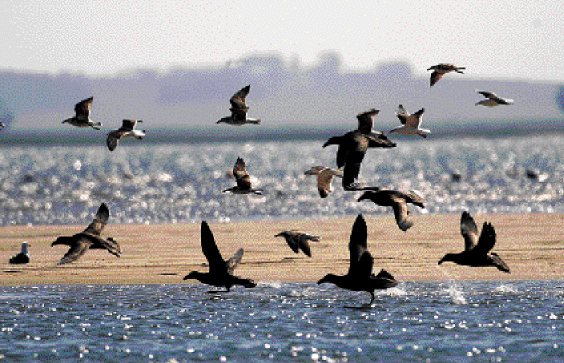
With funding from the U.S. National Institutes of Health’s Fogarty International Center, the UC Davis researchers helped Uruguayan university colleagues devise a simple water test that tells whether it is safe to drain flooded rice fields.
The test checks for the herbicide clomazone, which is used on 78 percent of Uruguay's rice fields.
Developing best rice-farming practices to avoid release of toxic chemicals to the environment is especially urgent in Uruguay, because water drained from the country's main area of rice cultivation flows into the marshlands of the Eastern Biosphere Reserve (Reserva de Biosfera Humedales del Este). This reserve is managed as part of the UNESCO Man and Biosphere Reserve Program, which promotes environmentally sustainable human development.
Monday, January 18, 2010
"UK meeting aims for new global biodiversity deal"
 Source: Richard Black, BBC News, 18 January 2010.
Ingredients of a new deal on protecting global biodiversity are likely to be decided this week at a London meeting.UNESCO is celebrating 2010, the United Nations Year of Biodiversity, and has an important program on People, Biodiversity and Ecology. Notable within this program is the world network of 553 bioreserves which has developed under UNESCO encouragement. The network provides a global mechanism for research and the development of the understanding needed to preserve biodiversity.
About 55 nations are sending delegates to the meeting, which will be chaired by UK and Brazilian ministers.
A key aim is to agree what sort of targets should be set at October's UN biodiversity summit for curbing the loss of species and ecosystems.
Editorial Comment: Unfortunately, the Bush administration withdrew U.S. support for the the participation of American scientists and U.S. bioreserves in the global network. The U.S. National Commission has recommended that the participation be restarted, and that remains a challenge for the new team appointed by the Obama administration. 2010, the Year of Biodiversity, would seem to require action on this recommendation.
John Daly
(The opinions expressed above are those of the author, and do not necessarily represent those of Americans for UNESCO.)
Monday, January 04, 2010
Africa Analysis: A level playing field for biodiversity
Source: Linda Nordling, SciDev.Net, 22 December 2009
Comment from the editor: UNESCO can play a key roll in the next few months helping African nations to plan for the October meeting, and indeed in participating in the International Year for Biodiversity and preparing for the long term effort needed to preserve and protect African biodiversity.

In 2010, the UN's International Year of Biodiversity, the world is expected to agree new goals for preserving species.
The Conference of Parties to the Convention on Biological Diversity (CBD), scheduled for late October next year in Nagoya, Japan, will also try to establish an international framework for ensuring more equitable access to, and sharing of, genetic resources.
But like many regions, Africa is already certain to fail to "achieve, by 2010, a significant reduction of the current rate of biodiversity loss" — the last CBD target set in 2002. Scientists say extinction rates are accelerating rather than slowing down and biodiversity-rich areas such as Africa are particularly vulnerable to the decline.
Will new targets for 2020 be any more achievable?
Comment from the editor: UNESCO can play a key roll in the next few months helping African nations to plan for the October meeting, and indeed in participating in the International Year for Biodiversity and preparing for the long term effort needed to preserve and protect African biodiversity.
It is especially important that the U.S. National Commission for UNESCO revive and support the U.S. committee for the UNESCO's People, Biodiversity and Ecology Program. The U.S. scientific community working in the field of biodiversity is the world's strongest, and UNESCO needs its active participation to achieve what is must in this important endeavor. JAD
Sunday, January 03, 2010
International Year of Biodiversity 2010

The United Nations has declared 2010 to be the International Year of Biodiversity. The year is to be a celebration of life on earth and of the value of biodiversity for our lives. The world is invited to take action in 2010 to safeguard the variety of life on earth: biodiversity.
UNESCO joins the Convention on Biological Diversity, the lead UN body and other UN, international and national partners to make the IYB an effective instrument to advance the cause of biodiversity conservation. During the Year, UNESCO will lead several activities which aim to educate and to raise public awareness on the reasons for conserving biodiversity, to fill the gaps in our knowledge of biodiversity and to catalyze further international action for its sustainable use.
Thursday, December 03, 2009
International Year of Biodiversity 2010
The UN-declared International Year of Biodiversity marks the 2010 Biodiversity Target aiming to significantly reduce the rate of biodiversity loss by this date.
UNESCO joins the Convention on Biological Diversity, the lead UN body and other UN, international and national partners to make the IYB an effective instrument to advance the cause of biodiversity conservation. During the Year, UNESCO will lead several activities which aim to educate and to raise public awareness on the reasons for conserving biodiversity, to fill the gaps in our knowledge of biodiversity and to catalyze further international action for its sustainable use.
Related links
- UNESCO and IYB
- Events and activities
- Inaugural event
- UNESCO IYB biodiversity science-policy conference
- IYB travelling exhibition
- International conference on cultural and biological diversity
- Biodiversity learning kit
- Resource materials
- UNESCO and biodiversity
- Official IYB website
- Official IYB Calendar
Monday, August 10, 2009
Biosphere Connections: Partnership Among the Star Alliance, UNESCO-MAB, Ramsar and IUCN

Established with the objective of promoting nature conservation and sustainable development, the Biosphere Connections partnership was launched in 2007 by the Global Airline coalition "Star Alliance" together with UNESCO-MAB, Ramsar Wetlands and IUCN.
Through Biosphere Connections, the Star Alliance will support UNESCO-MAB, Ramsar and IUCN in their conservation efforts and especially the local field scientists who conserve and manage biosphere reserves, wetlands, national parks and world heritage sites around the world. Similarly, UNESCO-MAB, Ramsar and IUCN will help Star Alliance airlines to further improve their environmental performance and their commitment to sustainable social and economic development, in the communities they serve and beyond.
Wednesday, May 27, 2009
UNESCO Names 22 New Biosphere Reserves
 Lagunas de Montebello, Chiapas, Mexico
The 21st session of the International Coordinating Council of the Man and the Biosphere Program (MAB-ICC) (held from 25 to 29 May 2009) added 22 new sites from 17 countries to the UNESCO's World Network of Biosphere Reserves (WNBR) which now counts 553 sites in 107 countries. Read more:
Sunday, January 11, 2009
Welcome to the Year of the Gorilla 2009
 The UNEP Convention on Migratory Species (CMS), the UNEP/UNESCO Great Ape Survival Partnership (GRASP) and the World Association of Zoos and Aquariums (WAZA) have joined hands to declare 2009 the Year of the Gorilla (YoG).
Dr. Jane Goodall is the official campaign patron.
Tuesday, December 16, 2008
New Orleans: a Model Urban Biosphere
Christine Alfsen informed me that the City of New Orleans has endorsed the project "New Orleans: a Model Urban Biosphere". Ms. Alfsen is the Senior Program Specialist for Sciences at the UNESCO Office in New York.
The program has the following specific objectives:
The brochure describing the project notes:
Tulane/Xavier Center for Bioenvironmental Research Deputy Director, Douglas Meffert, serves as the New Orleans coordinator for UNESCOʼs Urban Biosphere International Partnership of Cities which also includes New York and Phoenix (USA), Stockholm (Sweden), Cape Town (South Africa), Istanbul (Turkey), and Canberra (Australia). Read more about the Center's UrbanEco effort.
UNESCO has been involved with a major effort on People, Biodiversity & Ecology for many years, built around the Man and the Biosphere Program. UNESCO's Man and the Biosphere Urban Group is specifically backing this program in conjunction with the Urban Biosphere Network (URBIS), a collaboration between UNESCO and the Stockholm Resilience Center.
This project illustrates one of the ways in which the United States can benefit domestically from UNESCO's ability to form international networks in the sciences. The work of the scientists in New Orleans will be strengthened by their collaboration with researchers from other nations, and the combined body of knowledge from the comparative case studies will enrich our general understanding of urban ecology, and understanding which will in all probability improve the effectiveness of the reconstruction in New Orleans.
The program has the following specific objectives:
- Actively conduct and network research linkages between social and ecological issues;
- Provide a forum for the general public to inform and create community-driven solutions;
- Facilitate development of action-based, multidisciplinary projects working at the interface of human security and management of the natural environment; and
- Provide technical expertise and inform policy to international initiatives, programs and projects.
The brochure describing the project notes:
UNESCO has partnered with the Center for Bioenvironmental Research of Tulane University and the Stockholm Resilience Center in post-Katrina New Orleans and coastal Louisiana to create a world-class program to research urban ecosystems at risk.The work in New Orleans is one of a number of coordinated studies networked via ICLEI - Local Governments for Sustainability. You can see descriptions of the cases at this website.
Tulane/Xavier Center for Bioenvironmental Research Deputy Director, Douglas Meffert, serves as the New Orleans coordinator for UNESCOʼs Urban Biosphere International Partnership of Cities which also includes New York and Phoenix (USA), Stockholm (Sweden), Cape Town (South Africa), Istanbul (Turkey), and Canberra (Australia). Read more about the Center's UrbanEco effort.
UNESCO has been involved with a major effort on People, Biodiversity & Ecology for many years, built around the Man and the Biosphere Program. UNESCO's Man and the Biosphere Urban Group is specifically backing this program in conjunction with the Urban Biosphere Network (URBIS), a collaboration between UNESCO and the Stockholm Resilience Center.
This project illustrates one of the ways in which the United States can benefit domestically from UNESCO's ability to form international networks in the sciences. The work of the scientists in New Orleans will be strengthened by their collaboration with researchers from other nations, and the combined body of knowledge from the comparative case studies will enrich our general understanding of urban ecology, and understanding which will in all probability improve the effectiveness of the reconstruction in New Orleans.

Saturday, September 20, 2008
MAB Nomination Deadlines: September 30, 2008

The Man and the Biosphere Program (MAB) is an important element in UNESCO's overall People, Biodiversity and Ecology effort, which is in turn part of the organizations Major Program in the Natural Sciences.Since its creation in 1968, MAB has acted to encourage and facilitate protection of endangered ecosystems and sustainable approaches to development.
Biosphere reserves are sites recognized under UNESCO's Man and the Biosphere Program which innovate and demonstrate approaches to conservation and sustainable development. They are under national sovereign jurisdiction, yet share their experience and ideas nationally, regionally and internationally within the World Network of Biosphere Reserves. There are 531 sites worldwide in 105 countries.
The U.S. State Department makes a website available describing the U.S. contributions to the Man and the Biosphere program.Three deadlines, described in the following paragraphs, come on September 30 related to MAB. Since the U.S. Man and the Biosphere Committee is inactive it is suggested that interested parties contact the U.S. National Commission for UNESCO secretariat or the Permanent Mission of the United States to UNESCO.
Biosphere reserve nominations for 2008. The deadline for submission of new biosphere reserve nominations is 30 September 2008. The MAB National Committees are invited to submit biosphere reserve nominations (and/or extensions to existing biosphere reserves) in hard copy with the original signatures of endorsement and original maps, and also in electronic form as well as periodic review reports. Countries wishing advice may contact the MAB Secretariat or the Field Offices. The nomination and periodic review forms are available in English, French and Spanish. More
| |
| 30 September 2008
| |
| 30 September 2008 |
Thursday, July 24, 2008
New edition of the Man and the Biosphere Newsletter
The July 2008 issue of the Man and the Biosphere Newsletter has just been published.
In this issue
 Sustainable Management of the Dominican Republic's Only Biosphere Reserve
Building Capacity in Dryland Biosphere Reserves in West Africa
International Cooperation between Biosphere Reserves Strengthened
Sound Tourism Development in Biosphere Reserves in Central and Eastern Europe
Education Kit on Combating Desertification
Towards Joint Transboundary Management of the Marin Lagoon
Kruger to Canyon Biosphere Reserve Celebrates the International Biodiversity Day
VIII Meeting of the East Atlantic Biosphere Reserve Network (REDBIOS)
Training Programme on Regional Ocean Governance New Publications
New Publications
In this issue
Sustainable Management of the Dominican Republic's Only Biosphere Reserve Building Capacity in Dryland Biosphere Reserves in West Africa International Cooperation between Biosphere Reserves Strengthened Sound Tourism Development in Biosphere Reserves in Central and Eastern Europe Education Kit on Combating Desertification Towards Joint Transboundary Management of the Marin Lagoon Kruger to Canyon Biosphere Reserve Celebrates the International Biodiversity Day VIII Meeting of the East Atlantic Biosphere Reserve Network (REDBIOS) Training Programme on Regional Ocean Governance New Publications New Publications
Tuesday, July 08, 2008
The Complex Effects of Biosphere Reserves
Source: "Accelerated Human Population Growth at Protected Area Edges" by George Wittemyer, Paul Elsen, William T. Bean, A. Coleman O. Burton and Justin S. Brashares.
Science 4 July 2008: Vol. 321. no. 5885, pp. 123 - 126
A number of researchers from U.C. Berkeley have published a report in the current issue of Science magazine with the following Abstract:
The UNESCO program on Man, Biodiversity and Ecology provides an international mechanism for research on such issues. Indeed, its World Network of Biosphere Reserves, which includes 531 sites, provides one of the most effective (and cost-effective) means to encourage African, Asian and Latin American nations to set aside bioreserves and to develop sound plans for their protection. The Network also provides a means for a global community of scientists to collaborate in developing the knowledge and understanding for the management of bioreserves.
Science 4 July 2008: Vol. 321. no. 5885, pp. 123 - 126
A number of researchers from U.C. Berkeley have published a report in the current issue of Science magazine with the following Abstract:
Protected areas (PAs) have long been criticized as creations of and for an elite few, where associated costs, but few benefits, are borne by marginalized rural communities. Contrary to predictions of this argument, we found that average human population growth rates on the borders of 306 PAs in 45 countries in Africa and Latin America were nearly double average rural growth, suggesting that PAs attract, rather than repel, human settlement. Higher population growth on PA edges is evident across ecoregions, countries, and continents and is correlated positively with international donor investment in national conservation programs and an index of park-related funding. These findings provide insight on the value of PAs for local people, but also highlight a looming threat to PA effectiveness and biodiversity conservation.The article suggests the complexity of the landscape management challenge required by biosphere reserves. Without a global network of biosphere reserves that really work, mankind will lose access to huge amounts of biodiversity, with grave economic as well as cultural impacts. It is increasingly recognized that in poor countries, there has to be a development component in the management of a bioreserve to provide economic opportunities to the local population. Not only is such development ethically required, but it seems likely that local populations will otherwise over exploit what is intended to be the reserve. This paper, however, suggests that this approach may ultimately be self defeating, if the population growth around the bioreserve leads ultimately to its overexploitation anyway.
The UNESCO program on Man, Biodiversity and Ecology provides an international mechanism for research on such issues. Indeed, its World Network of Biosphere Reserves, which includes 531 sites, provides one of the most effective (and cost-effective) means to encourage African, Asian and Latin American nations to set aside bioreserves and to develop sound plans for their protection. The Network also provides a means for a global community of scientists to collaborate in developing the knowledge and understanding for the management of bioreserves.
Saturday, June 28, 2008
UNESCO Catalyzes Networks
UNESCO's budget is tiny when compared to the global governmental expenditures on education, science, culture and communications. Indeed, its total budget is much less than that of my local county for education.
UNESCO exercises no sovereign control over its member states. Each member state continues to exercise full sovereign control over its own people, territory and actions. UNESCO can not tell any state what to do, nor does it have any power to enforce the decisions of its governing bodies on its member states.
How then does it manage to achieve so much worldwide?
Examination of three networks of sites that have been created under UNESCO sponsorship provides one answer. They are:
In each case, UNESCO manages a review process to assure that nominees qualify for inclusion in the network and reviews the status of members of the network to assure that they still qualify. In each case, there is a subset of member states elected by the overall group of member states which is delegated oversight of the network, and a small bureau or secretariat to manage the networking functions.
In each case the member states have decided that the benefits of participation in the network more than justify the costs of participation. Decades of experience indicates that each network really works to promote cooperation among the sites included and to showcase important sites within the member nations to world attention.
The United States has been critically important in the creation of each of these networks, and Americans have provided intellectual leadership over the lifetime of each of them. Indeed, participation in each of these networks has provided a vehicle for cultural diplomacy, enabling the United States to achieve cultural and environmental objectives of its foreign policy in collaboration with other states. Through the collaborating networks these goals have not only been achieved more economically than would otherwise be possible, but indeed the goals might not have been at all possible without the collaboration of other sovereign states.
Finally, the networks provide the community of nations with an assurance of globally coordinated efforts to accomplish programs of global importance that would be beyond the capabilities of any member state alone.
UNESCO exercises no sovereign control over its member states. Each member state continues to exercise full sovereign control over its own people, territory and actions. UNESCO can not tell any state what to do, nor does it have any power to enforce the decisions of its governing bodies on its member states.
How then does it manage to achieve so much worldwide?
Examination of three networks of sites that have been created under UNESCO sponsorship provides one answer. They are:
- The World Heritage network of 851 natural and cultural sites of such importance as to justify the appelation;
- The World Network of 531 Biosphere Reserves which serve to develop and demonstrate landscape management systems and to serve as reservoirs of biodiversity;
- The Ramsar Convention network of 1755 wetland sites of international importance, totaling 161 million hectares.
In each case, UNESCO manages a review process to assure that nominees qualify for inclusion in the network and reviews the status of members of the network to assure that they still qualify. In each case, there is a subset of member states elected by the overall group of member states which is delegated oversight of the network, and a small bureau or secretariat to manage the networking functions.
In each case the member states have decided that the benefits of participation in the network more than justify the costs of participation. Decades of experience indicates that each network really works to promote cooperation among the sites included and to showcase important sites within the member nations to world attention.
The United States has been critically important in the creation of each of these networks, and Americans have provided intellectual leadership over the lifetime of each of them. Indeed, participation in each of these networks has provided a vehicle for cultural diplomacy, enabling the United States to achieve cultural and environmental objectives of its foreign policy in collaboration with other states. Through the collaborating networks these goals have not only been achieved more economically than would otherwise be possible, but indeed the goals might not have been at all possible without the collaboration of other sovereign states.
Finally, the networks provide the community of nations with an assurance of globally coordinated efforts to accomplish programs of global importance that would be beyond the capabilities of any member state alone.
Subscribe to:
Posts (Atom)