Showing posts with label International Hydrological Program. Show all posts

Saturday, December 01, 2012

A USGS and UNESCO Joint Publication

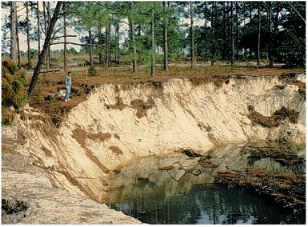
Development of a new irrigation well in west-central Florida triggered
hundreds of sinkholes over a 20-acre area. The sinkholes ranged
in size from less than 1 foot to more than 150 feet in diameter.
Land subsidence due to the depletion of groundwater is a problem in many parts of the United States. The subsidence, when it occurs, breaks water mains and sewer lines, disrupts underground telephone cables, and collapses roads. It can even endanger buildings. The problem costs many millions of dollars per year, straining the budgets of many municipalities.

The Guidebook was originally Published in 1984 by Unesco as one of the contributions to the International Hydrological Program. Although the IHP is a scientific and educational program, Unesco has been aware of the need to direct its activities toward the practical solutions of the world's water resources problems. The Guidebook was intended as one of the tools to help provide for a multidisciplinary approach to the assessment, planning, and rational management of water resources.

Written in 1984, the Guidebook provides an overview of case studies illustrating the major occurrences of land subsidence due to ground-water withdrawal throughout the world at the time of its publication. But probably it's most enduring contributions are the chapters on field measurement of deformation and the mechanics of land subsidence. These chapters provide a basic understanding of subsidence that is valuable for both resource managers and scientists.

The Guidebook has enjoyed enduring demand. It has long since been out of print, but now is available in electronic form. Click here to download Guidebook.zip, an 11 MB compressed file in Winzip format. Interested in only a part of the document? Check out the PDF files available here.

Friday, January 21, 2011

UNESCO: Enhancing flood management in Pakistan

© UN Photo/Evan Schneider - 
A view of heavy flooding caused by monsoon 
rains in Punjab Province, Pakistan (2010)
Last July’s catastrophic floods in Pakistan underlined the country’s need to better understand, predict and manage hydrological extremes – floods and droughts. To help strengthen Pakistan’s capacities, UNESCO is organizing a workshop at the National University of Sciences & Technology (NUST) in Islamabad from 24 to 26 January.

Friday, July 30, 2010

U.S. Delegation Attends IHP Intergovernmental Council

Former U.S. Mission Science Attaché Will Logan, U.S. Army Corps of Engineers (USACE); Head of Delegation Matt Larsen, U.S. Geological Survey (USGS); Ambassador and Mrs. Killion; Eugene Stakhiv, USACE; Verne Schneider, USGS; Jody Eimers, USGS
The Intergovernmental Council (IGC) of UNESCO's International Hydrological Program (IHP) met at UNESCO Headquarters in Paris July 5 – 9.  It was a noteworthy occasion for the United States, which recently became an IGC member and was elected to the seven-member IHP Bureau at the outset of the weeklong meeting. 

The IHP has been a leader in the field of hydrology since it was established in 1975 in order to facilitate intergovernmental cooperation in water sciences and water resource management.  Today, the IHP places a particular emphasis on hydrology as a component of sustainable development.  To meet its objectives, IHP coordinates water centers around the world, including the new International Center for Integrated Water Resources and Management (ICIWaRM) in the United States. 


Saturday, June 28, 2008

U.S. Participation in the IHP Council Meeting

The looming water crisis was the focus of the biennial International Hydrological Program (IHP) Intergovernmental Council (IGC) meeting, held at UNESCO headquarters from June 9-13, 2008.

Matt Larsen of the U.S. Geological Survey (USGS) headed the U.S. delegation, which included Verne Schneider, USGS, Bob Pietrowsky, U.S. Army Corps of Engineers (USACE), Gene Stakhiv, USACE, and Ross Corotis, U.S. National Commission to UNESCO. Among the approximately 200 participants were representatives of the 36 IGC Member States, as well as many other UNESCO Member States and non-governmental organizations. Matt Larsen was elected as the chair of the meeting’s drafting committee, which is influential in shaping the summaries of the major discussions and decisions.

Friday, May 09, 2008

U.S. Water Resources Conference in support of UNESCO’s IHP

A one-day workshop led by NSF and USGS in support of UNESCO’s IHP is to take place on June 27, 2008, in Washington, DC, at the U.S. Department of State.

The conference is to explore how to accelerate application of U.S. technology and knowledge to solve water resources and water quality management problems in developing countries. The participants will include high level representatives from U.S. agencies with interests and responsibilities for water, the Director General of UNESCO, Ambassador Louise Oliver, and leading U.S. scientists.

Expected outcomes are:
1. Recommendations for greater infusion of US science and technology into addressing water issues in developing countries.
2. Direct input into an upcoming international conference involving several hundred people that will be sponsored by the US Committee on Hydrology (with UNESCO) on “Water Scarcity, Global Change, and Groundwater Management Responses” and to be held December 1-8, 2008 in Irvine, CA
Two major topics for the June meeting will be integrated water resource management in semi-arid and arid regions, and meeting needs for potable water and sanitation in the rapidly expanding urban environments of developing countries.

IHP Burear Endorses U.S. UNESCO Center

The Bureau of the International Hydrological Program recently reviewed and endorsed the proposal of the United States of America for the establishment of an International Center for Integrated Water Resources Management (ICIWaRM) that would be hosted by the Institute for Water Resources of the U.S. Army Corps of Engineers and be set up in partnership with a consortium of U.S. universities and professional organizations. The latest regional meeting of IHP National Committees of Western Europe and North America – Region I (Istanbul, September 2007) had previously given its support to this U.S. proposal. Accordingly, the proposal is being forwarded to the forthcoming 18th session of the IHP Council.

Sunday, May 04, 2008

Editorial: The Importance of International Hydrology

Source: "Rivers and conflict: Streams of blood, or streams of peace," The Economist, May 1st 2008.

Water is obviously a critical resource for human life, for agriculture, and for many industries. Hydrology as the scientific study of water resources is obviously important, and becoming more important as demands for water increase and it becoming a scarce resource in more and more populated areas.

Equally obviously, water does not respect national boundaries. Rivers flow across them, and aquifers are not limited to a single nation's territory. Indeed, not only do weather and climate systems ignore such boundaries, but they can not be understood without regional and indeed global data. Thus the science of hydrology gains from being international.

These facts alone would justify UNESCO's hydrology program. However, as this blog's postings have often described, UNESCO's programs are fundamentally oriented towards building the defenses of peace in the minds of men through intellectual cooperation. UNESCO's International Hydrological Program provides a forum in which hydrologists from different nations can come together to work to develop cross-national programs, and thereby reach consensus as to the true status of water resources shared by their nations, and indeed on the likely impact of alternative management strategies of those resources.

Does that contribute to the search for peace. I extract from The Economist article:
Researchers at Oregon State University say they have found evidence......showing that the world's 263 trans-boundary rivers (whose basins cover nearly half the land surface of the world) generate more co-operation than conflict. Over the past half-century, 400 treaties had been concluded over the use of rivers. Of the 37 incidents that involved violence, 30 occurred in the dry and bitterly contested region formed by Israel and its neighbours, where the upper end of the Jordan river was hotly disputed, and skirmished over, before Israel took control in the 1967 war. And some inter-state water treaties are very robust. The Indus river pact between India and Pakistan survived two wars and the deep crisis of 2002......

The Nile is vast. Geographers still argue over exactly where the White Nile rises. Its tributaries and tendrils extend over a tenth of Africa's surface, and 160m people live in the river basin, in ten countries. That number is predicted to double within a few decades. These pressures, and Egypt's record of posturing and occasional threats, have been cited by some as a harbinger of war....

There is certainly a mounting conflict of interest between China and some neighbours over the use of two rivers that rise in Xinjiang, a region that the government in Beijing wants to develop and populate. The Chinese have diverted part of the Irtysh river, which feeds Russia's Ob river and ends up in the Arctic, to a canal supplying the booming oil town of Karamai. And China is also making more use of the Ili river, which ends up in Kazakhstan's Lake Balkhash, a vast, shallow expanse. Perhaps exaggerating, the UN Development Programme (UNDP) has said Lake Balkhash could turn into a salty mess, like the Aral Sea; and there are fears that wind-borne salt from its dried-up basin might speed the melting of glaciers on which China and Kazakhstan depend.....

For another “asymmetrical” relationship, take the one between Turkey, where the Tigris and Euphrates rise, and Syria and Iraq, both highly dependent on those rivers. Turkey's effort to build up to 22 dams on the two rivers is a constant source of tension, and tempers flared in 1990 when Turkey briefly interrupted the Euphrates.....

What about Israel, a country that (in matters aquatic, as in much else) views itself as eternally vulnerable while its neighbours often regard it as a hard-nosed bully? Israel's strategic situation was transformed after 1967: it no longer had to fight over water, and was able to co-operate “asymmetrically” with its neighbours in Jordan and (at least while the Oslo peace accords still worked) the Palestinians.

And as Israel builds up its capacity to turn sea water into fresh, a new form of co-operation has been proposed. This would involve pumping desalinated water from the Mediterranean to supply the West Bank—with the rider that Israel would retain access to a rich underground aquifer on the West Bank, under the terms of any settlement. This would lock the Palestinians into deep dependence on Israel.

Some of the gloomiest forecasts of water wars have focused on sub-Saharan Africa. The ever-cheerful UNDP said in 1999 that the basins of the Nile, Niger, Volta and Zambezi were all potential flashpoints. But even in Africa, outright inter-state war over rivers seems unlikely. As in other places, rivers in Africa often make for more neighbourliness, not less; the more countries a river passes through, the greater the regional co-operation. Indeed, as that UNDP report came out, Namibia and Botswana amicably accepted an international court ruling over an island in the Chobe river, a tributary of the Zambezi.
If the world is to continue its record of resolution of disputes over the allocation of increasingly scarce water resources it seems obvious that those negotiating water treaties and disputes will be well served by accurate, holistic hydrological knowledge gained through cooperative research and analysis, and agreed upon by a global consensus of hydrological experts.

UNESCO's hydrological program is modestly funded, making its impact by bringing together people and information. It makes a modest contribution to the maintenance of peace, but a contribution that alone may more than justifies its modest budget.

Wednesday, January 02, 2008

State Department Seeks Applications for a New U.S.-UNESCO Center

People don't think much about hydrology until something goes wrong due to a failure of the science; dikes fail flooding a city or flooding out crops due to flood conditions greater than had been predicted, or ground water is polluted due to errors in understanding the flow of pollutants, or an aquifer runs dry, or civil engineering works such as roads or bridges are washed out.

As important as hydrology is now, it is going to be even more important in the future. Climate change is going to change the availability of water resources. Population growth and movement, together with economic growth are going to increase demands on water resources -- probably to a degree that there will be chronic water shortages for many regions and many people in this century.

UNESCO's Natural Science program is the lead program in the United Nations system for hydrology. Much of its efforts are conducted through a network of centers. Indeed, since most of these centers are Category II, not receiving resources from UNESCO directly, the International Hydrological Program is importantly a network of self-financed institutions located in countries around the world.

The network of Category II water science centers is continuing to grow. The recent General Conference endorsed the establishment of the following (category II water science centers under the auspices of UNESCO:
  • Regional Centrefor Shared Aquifer Resources Management (Libyan Arab Jamahiriya);
  • International Groundwater Resources Assessment Centre (Netherlands);
  • Regional Centre for Water Management Research in Arid Zones (Pakistan);
  • International Centre on Hydroinformaticsfor Integrated Water Resources Management (Itaipú Binaciónal: Brazil–Paraguay);
  • Institute on a Partnership for Environmental Development (Italy).
The establishment of an International Centre of Water for Food Security at Charles Sturt University (Australia) was approved in principle, the final decision on the terms of the agreement being delegated to the Executive Board.

There is no Category II center in the United States of any kind, in part because the United States was not a member of UNESCO for so many years. Now however, the State Department has announced that it will accept applications for a U.S. water center that would perform theoretical and experimental research and advanced training, contribute to the execution of UNESCO's program, and increase the participation of national and regional institutions in UNESCO's efforts.

Applications for IHP Category II centers are considered on a biennial basis. The deadline for applications is next week (January 8th). The applications will first be reviewed by the U.S. National Commission for UNESCO. Those which are endorsed by the Commission and the Government will be passed to UNESCO, where they will be be the subject of feasibility studies, and ultimately considered by the next General Conference.

The U.S. National Committee for IHP has highlighted the following key aspects of the UNESCO IHP as priorities for U.S. collaboration:
  • Three focus areas: advocacy (of IHP programs and aims), research, and capacity-building
  • Three thematic areas: safe drinking water; global climate change; and water hazards
  • Support existing IHP programs: e.g. WWAP, PCCP, HELP, FRIEND, ISARM, IFI
  • Support UNESCO Category II Centers: Collaborate with existing Centers


A diagram of the hydrological cycle.