Showing posts with label Freedom.. Show all posts

Sunday, May 03, 2015

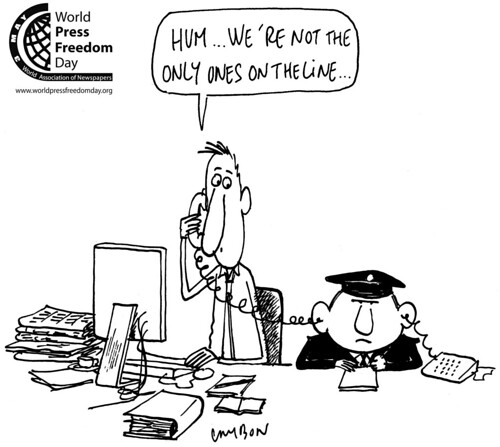
World Press Freedom Day, May 3


#KeepSpeechFree: UNESCO has joined forces with Google to promote freedom of expression in the online sphere, on World Press Freedom Day (3 May). They have developed a set of tools to help you better understand the threats to free expression online today – and what you can do about them:

* How to tackle digital risks, such as surveillance, location tracking, Man-in-the-Middle (MitM) attacks, Denial of Service (DoS) http://ow.ly/Mn1uM
* How internet companies can foster freedom online http://ow.ly/Mn1uM
* An analysis of freedom of expression & Internet privacy - where they support or compete with each other http://ow.ly/Mn1uM
* How media - including social media - are vital for sustainable development http://ow.ly/Mn1aD
* What's needed to build an internet that enhances free expression & human rights: http://ow.ly/Mn1fh 

Saturday, September 17, 2011

Inter-Agency meeting on the Safety of Journalists and the Issue of Impunity


A United Nations Inter-Agency meeting on the Safety of Journalists and the Issue of Impunity took place at UNESCO Headquarters in Paris on 13 and 14 September 2011. 
The event brought together representatives of UN system organizations and provided them with a forum in which to consult with other invited international and regional institutions, professional organizations and NGOs, with a view to formulating a comprehensive, coherent and action-oriented plan of action to address the issue of safety of journalists and the impunity of perpetrators of assaults against journalists.
Over the last ten years, more than 500 journalists and media workers have been killed worldwide, and many more were wounded or injured while carrying out their professional responsibilities. The great majority of casualties were not international war correspondents, but local journalists working in their own countries, mostly in peacetime, and covering local stories. In most of these cases, impunity precludes the way of justice, and if this trend prevails, journalists will remain easy targets.


Wednesday, September 14, 2011

UNESCO should protest attacks on journalists in Egypt

A CNN report titled "Angry crowd turns on journalists reporting embassy attack in Egypt" describes how a reporter, Dina Amer, was mobbed and trampled in Cairo last weekend. It went on to describe how CNN producer Mohamed Fadel Fahmy was also mobbed and trampled as he tried to protect Amer, and how other CNN reporters were unable to effect a rescue for some time. When Fahmy was able finally to carry Amer to a nearby car occupied by other reporters, and PBS reporter Margaret Warner began to drive away, the car was stoned by the mob. 
Other Egyptian journalists told CNN they were also attacked Saturday while trying to report near the Israeli embassy. 
Ahmed Aleiba, a correspondent with Egyptian state television, said he was pursued by civilians and soldiers. 
"I had to run because obviously they were targeting journalists," Aleiba said in a phone call with CNN. "They attacked two other TV crews."
The article goes on to recount other, earlier occasions in which reporters were attacked by Egyptian demonstrators over the past year.

I would strongly recommend that UNESCO express its concern for the safety of journalists covering the events in the Middle East and North Africa, and condemn the acts of mobs in threatening and/or attacking these journalists.

John Daly
The opinion expressed in this post is that of the author and does not necessarily reflect that of Americans for UNESCO.


Thursday, December 23, 2010

International Symposium on Freedom of Expression


UNESCO is holding an ‘International Symposium on Freedom of Expression‘ on 26 January 2011, with the support of the Swedish National Commission for UNESCO. The meeting will gather some 300 participants including government officials, policymakers and World Press Freedom Prize winners, representatives of major non-governmental organizations, and media professionals.

This event provides an excellent opportunity for UNESCO to reiterate its values and mandate, particularly its mission to promote the free flow of ideas by word and image. Indeed, the Organization has always promoted the value of information and communication for “advancing the mutual knowledge and understanding of peoples”, and has emphasized the links between the free flow of ideas and the broader objective of preventing wars and constructing the defenses of peace.

One panel session will focus on freedom of expression on the Internet. It is expected that the UNESCO publication from the Oxford Internet Institute, entitled ‘Freedom of Connection – Freedom of Expression‘, will be launched. A penultimate draft of the manuscript is online at SSRN, but a print version will be available by the date of the symposium.

Saturday, May 08, 2010

Luncheon in New York focused on information for empowerment

More than 75 United Nations delegates, journalists and representatives of media advocacy groups attended the World Press Freedom Day luncheon programme held at the UN Secretariat on 3 May. In line with the theme of this year, the event focused on the basic role of media, which is information for empowerment.
Participants particularly stressed that the right to information is a precondition of all other rights, such as the right to food and shelter, the right to education, or the right to vote. In the context when the international community has to intervene more frequently in post-conflict and post-disaster situations, the right to know is more important than ever.

Friday, April 16, 2010

Mónica González Mujica to receive UNESCO/Guillermo Cano World Press Freedom Prize 2010

The Chilean journalist, Mónica González Mujica, a heroine of the struggle against dictatorship in her country, has been named laureate of the 2010 UNESCO/Guillermo Cano World Press Freedom Prize.

“Throughout her professional life, Mónica González Mujica has shown courage in shining the light on the dark side of Chile,” said the President of the jury, Joe Thloloe, Press Ombudsman of the Press Council of South Africa. “She has embodied the very spirit of the Award. She has been jailed, tortured, hauled before the courts but has remained steadfast.”

“Ms González is now ploughing her experience back to the younger generation through her work at the Center of Journalism and Investigation and her workshops on investigative journalism in various countries,” added Mr Thloloe.

Tuesday, February 02, 2010

World Press Freedom Day, 2010

The University of Queensland in Brisbane Australia has launched the official 2010 World Press Freedom Day global conference website at www.wpfd2010.org.

Friday, January 15, 2010

UNESCO urges 'Malsin's immediate and unconditional release'

The Ma'an News Agency reports the following:
UNESCO and the office in the occupied Palestinian territories and Gaza strip is expressing deep concern about the detention of the Chief English Editor of the Ma'an News Agency, Mr. Jared Malsin, a U.S. citizen, by the Israeli authorities at the Ben Gurion International airport on 12 January, 2010 and the plans to deport him.

Ma'an is editorially independent and pluralistic Palestinian news agency, based in Bethlehem. During the past five years, UNESCO has worked together with Ma'an to supported several initiatives and projects in cooperation with Ma'an that promote freedom of expression, access to information and development of the Palestinian society.

Tuesday, December 08, 2009

UNESCO chief speaks out at murder of another Mexican journalist


The head of the United Nations agency tasked with defending press freedom has condemned the murder of Mexican journalist José Emilio Galindo Robles, the second such killing in less than one month.

Wednesday, July 22, 2009

The Right to Information in Latin America: A Comparative Legal Survey

This legal survey, published by UNESCO’s Office in Quito, compares the existing right to information laws in 11 Latin American countries: Chile, Colombia, Dominican Republic, Ecuador, Guatemala, Honduras, Mexico, Nicaragua, Panama, Peru and Uruguay.

Thursday, June 04, 2009

"Freedom of information: a comparative legal survey"


The importance of the right to information or the right to know is an increasingly constant refrain in the mouths of development practitioners, civil society, academics, the media and governments.

What is this right, is it really a right and how have governments sought to give effect to it? These are some of the questions this book seeks to address, providing an accessible account of the law and practice regarding freedom of information, and an analysis of what is working and why.

Monday, May 04, 2009

Director-General condemns murder of Colombian journalist José Everardo Aguilar

The Director-General of UNESCO, Koïchiro Matsuura, has condemned the brutal killing of Colombian journalist José Everardo Aguilar in the south western town of Patia, 450 kilometres south of the capital Bogotá, on 24 April.

According to Roy Greenslade:

Veteran Colombian journalist José Everardo Aguilar, a noted critic of official corruption, has been shot dead on his doorstep. The 72-year-old, who worked for several radio stations including Radio Súper Popayán, was killed when he answered the door of his home in Patia, 450 kms south of Bogotá, thinking it was a delivery man.

"This is the gravest in a series of attacks against colleagues all around the country," said Eduardo Márquez, president of the Federation of Colombian Journalists, which believes the murder is a tactic to silence the press.
Editor's note: Popayan is a beautiful small city full of buildings reflecting its colonial past, the capital of the Colombian state of Cauca. It seems so sad that the violence continues in Colombia, a land of such beauty whose citizens were so kind to me when I lived there. JAD

Saturday, May 02, 2009

2009 World Press Freedom Day Debate:

Controlling the International Media in War - Are governments winning the Battle?


The debate was held May 1st, although World Press Freedom Day is actually May 8th.

Thursday, April 30, 2009

World Press Freedom Day 2009

UNESCO is organizing World Press Freedom Day celebration, from 2 to 3 May 2009 in Doha, the capital of Qatar. It will focus on the potential of media in fostering dialogue, mutual understanding and reconciliation.

The international conference will gather prominent media professionals and representatives of major non-governmental organizations from different parts of the world. This year, UNESCO invites participants to explore the enormous potential of media to serve as a platform for dialogue and a vehicle for understanding.

Friday, April 24, 2009

World Press Freedom Day

World Press Freedom Day 2009:

Dialog, mutual understanding and reconciliation

A UNESCO conference will mark World Press Freedom Day 2009. The conference is to be held in Doha (Qatar) on 2 and 3 May. During the conference, uNESCO Director General Matsuura will present the 2009 World Press Freedom Prize, awarded posthumously to murdered Sri Lankan journalist Lasantha Wickrematunge.

Sunday, January 11, 2009

"Press freedom and development:

an analysis of correlations between freedom of the press and the different dimensions of development, poverty, governance and peace"

Guseva, Marina; Nakaa, Mounira; Novel, Anne Sophie; Pekkala, Kirsi; Souberou, Bachir; Stouli, Sami
UNESCO, 2008. (133 pages)

This study is the outcome of a research project implemented by the Centre for Peace and Human Security (CPHS) at Sciences Po University with support by UNESCO. The initial idea was to gather and collate quantitative and qualitative evidence of correlations between the indicators of environments conducive to media freedom and independence and the indicators of human development, human security, stability, poverty reduction, good governance and peace.

Sunday, December 07, 2008

Editorial: UNESCO Withdraws from RWB Online Free Expression Day

Reporters Without Borders last week launched the "Online Free Expression Day".
“From now on, we will organise activities every 12 March to condemn cyber-censorship throughout the world,” Reporters Without Borders said. “A response of this kind is needed to the growing tendency to crack down on bloggers and to close websites."
The organization has issued an updated list of “Internet Enemies” as part of its actions to mark this day.
There are 15 countries in this year’s Reporters Without Borders list of “Internet Enemies” - Belarus, Burma, China, Cuba, Egypt, Ethiopia, Iran, North Korea, Saudi Arabia, Syria, Tunisia, Turkmenistan, Uzbekistan, Vietnam and Zimbabwe. There were only 13 in 2007. The two new additions to the traditional censors are both to be found in sub-Saharan Africa: Zimbabwe and Ethiopia.

“This is not at all surprising as these regimes regularly hound the traditional media,” Reporters Without Borders says in the introduction to its report.“Internet penetration is very slight, but nevertheless sufficient to give them a few nightmares. They follow the example of their seniors and draw on the full arsenal of online censorship methods including legislation, monitoring Internet cafés and controlling ISPs.”

There is also a supplementary list of 11 “countries under watch.” They are Bahrain, Eritrea, Gambia, Jordan, Libya, Malaysia, Sri Lanka, Tajikistan, Thailand, United Arab Emirates and Yemen. Unlike the “enemies,” these countries do not imprison bloggers or censor the Internet massively. But they are sorely tempted and abuses are common. Many of them have laws that they could use to gag the Internet if they wanted. And the judicial or political authorities often use anti-terrorism laws to identify and monitor government opponents and activists expressing themselves online.
Simultaneously, RWB reported:
Reporters Without Borders learned last night that UNESCO has withdrawn its patronage for today’s Online Free Expression Day. We were notified of the decision by the director of its Freedom of Expression, Democracy and Peace Division. Defending the move, UNESCO said it gave its patronage for the “principle of this day” but could not support the various demonstrations organised to mark it.
UNESCO's charter calls for it to support freedom of information and the press, and UNESCO has supported RWB in the past:
More than a third of the world's people live in countries where there is no press freedom. Reporters Without Borders works constantly to restore their right to be informed.
I was unable to find an explanation on the UNESCO website of its withdrawal, and indeed I was unable to find any mention of "Online Free Expression Day." However, the Latin American News Agency (headquartered in Havana, Cuba) Prensa Latina reports:
A UNESCO diplomatic source told Prensa Latina on Wednesday that the UN body had made the decision based on RSF´s "reiterated lack of ethics" and its attempts to discredit a given number of countries.

UNESCO"s profile or purposes are not in line with RSF"s performance for sensationalist interest nor it is acting as a court of inquisition for developing nations, the source said.

For this and other causes the UN body definitely declared the relation with RSF closed, and excluded any kind of collaboration in the future.
Editorial comment: It has always seemed to me that Reporters Without Borders is a highly reputable organization, performing an important function. I agree that the analysis by RWB is probably correct:
“We are not fooled,” Reporters Without Borders said. “Several governments on today’s updated list of 15 ‘Internet Enemies’ put direct pressure on the office of the UNESCO director general, and deputy director general Marcio Barbosa caved in. UNESCO’s reputation has not been enhanced by this episode. It has behaved with great cowardice at a time when the governments that got it to stage a U-turn continue to imprison dozens of Internet users.”
The United States Government should investigate UNESCO's conduct in this matter. If indeed UNESCO has yielded to the pressures of countries identified by RWB as impinging on freedom of expression on the Internet and is withdrawing from its charter responsibilities to safeguard freedom of expression the U.S. Government should make the strongest possible protest.

John Daly
(The opinion is that of the author and does not necessarily represent that of Americans for UNESCO.)

Friday, October 24, 2008

UNESCO Symposium and exhibition on freedom of expression mark 60th anniversary of Universal Declaration of Human Rights

U Win Tin
Laureate of the UNESCO
World Press Freedom Prize 2001
long term prisoner in Burma
has provided a video for the symposium

A symposium on Freedom of Expression: Development, Democracy and Dialog will be held at UNESCO Headquarters on 29 October as part of celebrations of the 60th anniversary of the Universal Declaration of Human Rights whose 19th article enshrines freedom of expression as a fundamental, inalienable human right.

Friday, September 26, 2008

Myanmar releases U Win Tin, laureate of 2001 UNESCO/Guillermo Cano Press Freedom Prize

U Win Tin after his release
© RSF

Source: UNESCO Communications News Service (24-09-2008)

Director-General of UNESCO, Koïchiro Matsuura, expressed his “immense joy” over the release by the authorities of Myanmar of U Win Tin, the 2001 laureate of the UNESCO/Guillermo Cano Press Freedom Prize, after 19 years in prison.

Aged 79, U Win Tin is the former editor of the daily Hanthawati newspaper, vice-chair of Myanmar's Writers' Association and a founder of the National League for Democracy, which is led by Aung San Suu Kyi who remains under house arrest.

He was arrested in July 1989 and was accused of belonging to the banned Communist Party of Myanmar. Condemned to 14 years jail, he received an additional sentence of five years in 1996 for breaking prison regulations prohibiting the possession of writing materials.

UNESCO promotes freedom of expression and freedom of the press and fosters media independence and pluralism as part of its fundamental mission. It does so primarily by providing advisory services on media legislation and by making governments, parliamentarians and other decision-makers aware of the need to guarantee free expression.

However, the Director General is a constant voice protesting violence against or imprisonment of journalists. The World Press Freedom Prize (named in honor of assassinated Colombian journalist Guillermo Cano) is awarded annually on the occasion of World Press Freedom Day. While, as the long prison term of U Win Tin illustrates, UNESCO is not always successful in protecting journalists, it is an important element in the global effort to assure freedom of the press.