Thursday, May 30, 2013

The CRS has made a report on UNESCO for the U.S. Congress.

Luisa Blanchfield and Marjorie Ann Browne of the Congressional Research Service have produced a report on UNESCO for the U.S. Congress. The report was published on March 18, 2013.

Here are my comments on the report:
The report may leave the impression that the member states of UNESCO granted membership in the organization to the PLO. They granted membership to Palestine. 
In considering whether Palestine has "the internationally recognized attributes of statehood" you might mention that 107 member states of UNESCO elected Palestine to be a fellow member state. 138 members states of the United Nations have also elected Palestine to the status of "non-member observer state", not "observer organization". According to Wikipedia, as of April of this year 132 of the 193 member states of the United Nations have recognized the State of Palestine. 
You might also have noted that -- in spite of the provisions of the law -- the United States has continued to fund a number of UN agencies that include as member states entities that do not have "the internationally recognized attributes of states".  
The United States did not make a "decision to withdraw from the UNESCO between 1984 and 2003." It made a decision to withdraw from UNESCO in 1984. 
The United States made a separate decision to rejoin UNESCO in 2003. It was explicitly stated at that time that the effectiveness of UNESCO justified membership. UNESCO effectiveness had been further improved after 2003, although it has been damaged since 2011 by the United States withholding funds. 
You address several issues being considered with respect to the U.S. withholding funds from UNESCO. One that you might consider is the effect on U.S. foreign policy. I believe many UNESCO member states feel that the United States is acting inappropriately by refusing to accept the vote of the majority of member states. That and the soon to occur loss of the U.S. vote will compromise the Department of State's ability to achieve foreign policy aims in and through UNESCO. 
In discussing the budget of UNESCO, you do not mention the voluntary contributions which have been comparable in magnitude to the assessed contributions. The U.S. contribution of 22% of the regular budget influences the total program of UNESCO, and should be seen as roughly 11% of that total. 
Thank you for your attention. 
Here is a more complete set of comments on the study by Ray Wanner.

Monday, May 13, 2013

Just published: 2012-2013 map of the World Network of Biosphere Reserves


The new 2012-2013 map of the World Network of Biosphere Reserves shows the worldwide distribution of the 610 biosphere reserves located in 117 countries, including 12 transboundary/transcontinental sites. The map is available in English, French and Spanish, and also includes an overview of the objectives, tasks and structures of these areas.

The world map was prepared by the UNESCO's Man and the Biosphere Program with the support of the Spanish Government.

Wednesday, April 17, 2013

Statement by U.S. Ambassador David Killion to the 191st Executive Board

"My Administration continues to work with our Congress to resolve the issue so that we can meet our commitments to UNESCO.   Of course, I had hoped to be able to report at this Board that this was solved, but unfortunately that is not yet the case.  However, we will not give up.  On April 10, President Obama delivered his budget request to the Congress.  His budget includes a formal request for a waiver of the suspension of U.S. funding to UNESCO.  It also includes funding for this year and previous years.  We will keep pushing our rock up the hill until we reach the top because, we agree, the current situation is not sustainable."

The Transatlantic Slave Trade and Slavery: New Directions in Teaching and Learning


The Harriet Tubman Institute and the Slave Route Project have announced the launching on 16 April at UNESCO headquarters a new title in the Harriet Tubman Series on the African Diaspora: “The Transatlantic Slave Trade and Slavery: New Directions in Teaching and Learning”.

Edited by Paul E. Lovejoy and Benjamin Bowser, this book is an anthology of papers from an international workshop that the Slave Route Project jointly organized in November 2010 in Toronto, Canada, with the Harriet Tubman institute and the Canadian Commission for UNESCO, in order to define new approaches for teaching the slave trade and slavery and to examine the psychological consequences of this history.

Read more!

Monday, April 15, 2013

Two Important UNESCO Documents

Americans for UNESCO resolution to restore US UNESCO funding http://j.mp/15aXUS9

U.S. Congressional Research Service 2013 report on UNESCO http://j.mp/12fKhOF

Sunday, April 14, 2013

The United States Government Should Restore Funding to UNESCO

Countries that have recognized the State of Palestine.Source: Night w

The United States policy is that a two state solution is needed to resolve the long standing dispute between Israelis and Palestinians. According to Wikipedia, "of the 193 member states of the United Nations, 132 (68.4%) have recognized the State of Palestine as of April 2013.  On 29 November 2012, the General Assembly granted Palestine non-member observer state status in United Nations General Assembly resolution 67/19." UNESCO granted membership to Palestine in 2011.

U.S. law requires that the government withhold funding from any United Nations agency that accepts Palestine as a member state. Apparently, two decades ago when the legislation was passed and signed into law, it was felt that recognition of Palestine by UN agencies would militate against the successful negotiation of an agreement between Israel and Palestine settling their disputed border and the management of their territories.

The Need for the Legislation to Be Revised

The legislation is badly worded. The operative portion reads:
"The United States shall not make any voluntary or assessed contribution - (1) to any affiliated organization of the United Nations which grants full membership as a state to any organization or group that does not have the internationally recognized attributes of statehood, or (2) to the United Nations, if the United Nations grants full membership as a state in the United Nations to any organization or group that does not have the internationally recognized attributes of statehood, during any period in which such membership is effective."
It is not clear what constitutes "an affiliated organization of the United Nations". It seems likely that the term would include the International Monetary Fund, the World Bank and the other International Financial Institutions, the World Health Organization, the World Intellectual Property Organization, and many other organizations. Nor is it clear what states fail to have "the internationally recognized attributes of statehood". Do Somalia and Syrian Arab Republic meet that definition in spite of their failed governments? Does Palestine not meet that definition in spite of the fact that most of the world's nations have recognized it as a state?

Given this lack of clarity in the provision, it might be that the U.S. Government would have to withhold funding from the World Bank (which includes both Somalia and the Syrian Arab Republic as member states) and other agencies critical to our nation/s interests.

The provision also has no sunset clause so no matter how conditions change in the future it will continue in force until there is an act of Congress to change or repeal it.

There is a simple solution to the revision of the legislation. Amend it to give authority to the President to waive the provision if he finds it to be in the nation's interest to do so. The Congress will of course continue to define the contributions to UN agencies through appropriations legislation and can withhold funding from any international agency that it chooses.

Restore Funding to UNESCO

Last week the administration requested funding for UNESCO in its FY2014 State and Foreign Operations budget proposal:

The Administration seeks Congressional support for legislation that would provide authority to waive legislative restrictions that, if triggered, would prohibit paying U.S. contributions to United Nations specialized agencies that grant the Palestinians the same standing as member states or full membership as a state. Should the Congress pass this waiver legislation, the FY 2014 funding specifically requested for UNESCO would cover the FY 2014 UNESCO assessment and the FY 2013 and FY 2014 Contingent Requirements funding would cover arrears which accrued in FY 2012 and FY 2013. 
 The administration is no doubt referring to UNESCO's programs in education, science, culture and communications. UNESCO has been notably supportive of U.S. policy objectives in Iraq, Afghanistan and Pakistan implementing programs supported by voluntary contributions.

Perhaps more important is the fact that there is a huge network of people and organizations worldwide that affiliate themselves with UNESCO's objective of building the defenses of peace in the minds of men. Those networks include national commissions for UNESCO, people and organizations supporting World Heritage sites, educators implementing Education for All, scientists involved in UNESCO's network of biosphere reserves, those involved in UNESCO's regional tsunami warning systems, scientists involved in UNESCO's many water centers and programs, and many others. It is important that the United States continue to show its support for UNESCO's mission so that these people will retain their respect for the United States.

Kensington Maryland Celebrates UNESCO's International Day of the Book

Saturday, April 13, 2013

UNESCO should get more emotional and less cerebral! -- the need for peace demands it do so.

Since wars begin in the minds of men, it is in the minds of men that the defences of peace must be constructed......
The States Parties to this Constitution, believing in full and equal opportunities for education for all, in the unrestricted pursuit of objective truth, and in the free exchange of ideas and knowledge, are agreed and determined to develop and to increase the means of communication between their peoples and to employ these means for the purposes of mutual understanding and a truer and more perfect knowledge of each other’s lives;
In consequence whereof they do hereby create the United Nations Educational, Scientific and Cultural Organization for the purpose of advancing, through the educational and scientific and cultural relations of the peoples of the world, the objectives of international peace and of the common welfare of mankind for which the United Nations Organization was established and which its Charter proclaims. 

The UNESCO Constitution
UNESCO, in keeping with its Constitution, takes a very cerebral approach to building the defenses of peace in the minds of men. How about people's emotions?

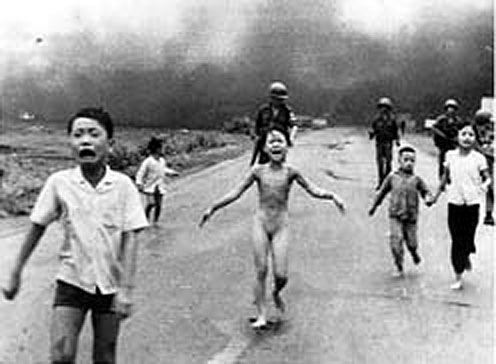
Huynh Cong "Nick" Ut photo via

THREE IMAGES: The Effects of Photojournalism on the Protest Movement during the Vietnam War


As I recall the U.S. public response to the war in Vietnam, it differed from that to previous 20th century wars because we saw it covered on television. Pictures, especially moving pictures affect the brain differently than do written words and statistics. If UNESCO wants to create defenses of peace in the brains of men, not just in their minds, then it must complement its cerebral approach with an approach that is also emotional.

Cognitive science has advanced a great deal since the time of the birth of UNESCO. We understand that people are not simply rational. We think with our brains and our thought is not just logical and rational, but also emotional. Some of our decisions are made slowly and based on analysis, others are made quickly and based on intuition. Some of our intuitions seem to be hard wired and others learned. UNESCO more than any other UN organization should understand the advances in science and their implications for how it is to go about its mission.

Indeed, we must recognize that learning has emotional aspects as well as cerebral and moral; science may be cerebral, but scientists are emotional. The sites and objects of our cultural heritage have not only aesthetic content, but affect us emotionally. Communications have emotional content. UNESCO should be emotional as well as cerebral.

There are fewer that 2000 people employed in UNESCO's secretariat. There are many, many more people who are affiliated with UNESCO's purpose though its National Commissions, associated schools, UNESCO clubs, world heritage sites, and other UNESCO networks. I hope and believe this larger network of people advance the defenses of peace in the brains of men (and women and children) using all the available means.

Saturday, April 06, 2013

Successful Caribbean test demonstrates progress in regional tsunami readiness

Over 44,000 people from 30 Members States and 15 of the territories* in the Caribbean and Adjacent Regions participated in the second full scale regional tsunami exercise held on March 20, 2013. The goal was to test the Tsunami and other Coastal Hazards Warning System for the Caribbean and Adjacent Regions (CARIBE EWS), which was established in 2005 by the countries of the region in collaboration with UNESCO’s Intergovernmental Oceanographic Commission (IOC), ensuring that the national focal points responsible for the dissemination of the alert and first responders receive timely warning.


The exercise was initiated with a first dummy message issued by the Pacific Tsunami Warning Center (PTWC) and the West Coast and Alaska Tsunami Warning Center (WC/ATWC), at 13:02 UTC (9:02 AST) and disseminated over its standard broadcast channels to all its stakeholders and focal points. The message was issued according to schedule to the official Tsunami Warning Focal Points, and none of the institutions have reported issues with the reception of the message from the Tsunami Warning Center.
The Puerto Rico Seismic Network and other national and regional organizations also issued messages for its areas of responsibility. Sirens, emails, emergency alert systems, text messages, media outlets, NOAA weather radio, and social media were used by many focal points to further disseminate the messages. In addition to the communication tests, exercises were conducted at various additional levels of magnitudes and sophistication and included seminars, table top exercises, video/web conferencing and drills.   

Allison Sharpe Wright Appointed Executive Director of the National Commission for UNESCO

Thursday, March 28, 2013

U.S. Government Scientist Wins UNESCO Prize

Professor Deborah JIN is a 2013 laureate of the L’ORÉAL-UNESCO Awards for Women in Science. Professor Deborah Jin and her team invented an ingenious method of cooling molecules down to near absolute zero, the lowest possible temperature – which has the effect of slowing them down. In fact, they slow down enough for researchers to actually see what goes on during chemical reactions. The study of ultra-cold molecules could lead to new precision-measurement tools, new methods for quantum computing and help us better understand materials that are essential to technology.

Read more:


Thursday, March 21, 2013

Happy World Water Day: March 22nd

Freshwater is a vital element for human existence and all ecosystems on Earth. This finite resource is an essential ingredient for life and socio-economic development: we need it for food production, energy, industrial and domestic uses. It faces severe pressure from increasing demands to satisfy the needs of a growing population, rapid urbanization, pollution and climate change.


Cooperation is essential to strike a balance between the different needs and priorities and share this precious resource equitably. Since water cuts across all sectors, stakeholders that are not traditionally considered to be water managers must participate. Water cooperation between different social groups, economic sectors, regional governments, countries, and present and future generations, is crucial not only to ensure the sustainable and equitable use of water but also to create and maintain peaceful relations between people.

In 2013, in celebration of the International Year of Water Cooperation, World Water Day is also dedicated to the theme of cooperation around water.


Sunday, March 17, 2013

UNESCO and the science of mind,


I have been involved in a discussion on the UNESCO's Friends group on Linked In of the biology of mind and the need for an international venue for discussion of the policy implications of the emerging science and its technological repercussions.

Scientists have been illuminating the incredible plasticity of the brain. That plasticity is not that the different organs within the skull migrate physically. Scientists now know that the number of neurons in the brain peaks during early childhood and then some die not to be replaced; they also have shown that there remain stem cells in the brain and new neurons are created long into adult life. Still it is believed that most of the changes are in the connections among neurons and the ability of neurons to excite or inhibit the actions of other neurons.

The biology of mind seems to be an emerging discipline. Imaging techniques, electrical recording techniques and molecular biology are combining to produce rates of scientific knowledge production in this area that were hardly imaginable a couple of decades ago. It seems likely that the burgeoning of knowledge will lead to important applications. This turning point might turn out to be similar to semiconductor physics leading to semiconductor electronics or atomic physics leading to nuclear energy.

We now know the Flynn Effect, that average performance on IQ tests is improving:
The average rate of increase seems to be about three IQ points per decade in the U.S. on tests such as the WISC. The increasing raw scores appear on every major test, in every age range and in every modern industrialized country although not necessarily at the same rate as in the U.S. using the WISC. The increase has been continuous and roughly linear from the earliest days of testing to the present.
This may be because people are increasingly learning things measured by IQ tests instead of other unmeasured things that they learned in the past, or perhaps because people are on average actually becoming more intelligent. (Perhaps a smaller part of the population are subject to poor nutrition and childhood diseases that limit the development of the brain, or are subject to poor intellectual environment and inadequate schooling that would limit their learning opportunities.) Whatever the explanation, since IQ test performance is clearly a function of the behavior of the brain, on average, the brain of today (in industrialized countries) is different than was, on average, the brain of yesteryear.

I see no reason to believe that brains will not continue on the average to change. I would suggest that our objectives in schooling and in lifelong learning would be to encourage brain development, on average, in beneficial directions. Schooling has tended to focus on facts and analysis. Perhaps it should focus more on other aspects of learning. For example, perhaps it should seek to assure that learning excites the pleasure centers of the brain.

Homo sapiens are social animals, and there is evidence that we make better decisions in groups than as individuals. Perhaps we need to consider the biology of the group mind. Perhaps schooling should include specific efforts to help people learn better how to think together, to solve problems in groups.

It has also been suggested that we think with our surround. In my father's day (born in 1905 in Ireland) it made sense for schools to promote the development of memory; in my youth (born 1937) we were taught library skills but had less memory training; today's infants will be brought up with hand-held devices connected to the Internet and will be taught to find and evaluate information from cyberspace. So too, modern schooling should help people learn to use the analytic capabilities of computers to amplify their own analysis.

My point is that the improving science of the biology of the mind should be reflected in changes in educational policy. This would seem to be an area of special concern for UNESCO with its emphasis on both education and science. UNESCO also has for decades focused on the ethics of science and technology and bioethics, and there are clearly ethical issues in educational policy raised by the emerging science of the biology of mind.

However, that is but one area of policy that should reflect our emerging knowledge of mind. Clearly psychiatric policy will change as we better understand the brain, and as we develop better technology for diagnosis and treatment of brain dysfunctions; given the relation of "physical" and "mental" health, better science of the mind might also lead to more general changes in medical policy.

Legal policy may well change as we learn more about the brain and the biological bases of decisions and behavior. That seems obviously true for criminal justice, but it may also be true in areas such as legislation regarding marriage/

Information is accumulating as to the interplay between culture and the biology of mind. We know that the language we learn as children influences the allocation of space in the brain to different mental functions. We also know that culture is plastic -- that the cultures of today's nations have changed from the cultures of their predecessors. Not only are Western cultures different today than they were a century ago, but so too are "indigenous" cultures in Asia, Africa and the Americas. Perhaps we might induce positive changes in culture for our descendants through examination of the increasing knowledge of the biology of mind -- perhaps promoting cultures of peace and improved understanding among cultures. Again, UNESCO focuses on culture, science and ethics, so the ethical dimensions of the impact of the biology of mind on cultural change seems a natural area for UNESCO's concern.

UNESCO has served as a forum for discussion, a laboratory and a clearinghouse for ideas. Those are just the functions most immediately needed with respect to the science of mind!

Friday, March 08, 2013

Christiane Amanpour, CNN, on Gender Equality


Christiane Amanpour underscores the need for gender equality in all aspects of society and specifically in and through media: "From all my experience working in the field for over 20 years now I see more and more women in the field as journalists... What I see is that this is making a big change in the way stories are covered. Women do not report only on women... They report on what now is almost exclusively the human factor when it comes to war, crisis, disaster or even opportunities, hope and challenges... Women still have to face very difficult threats, very difficult situations of abuse, very difficult situations of intimidation and out and out being banned from taking part in the field of journalism. It is still a difficult world... Those of you women around the world who are determined, and no matter what profession you choose, who are determined to make it and battle the odds and make sure that you never hear the word NO, that I think is the hope and the optimism and the opportunity that we can benefit from and that we can put back into society..."

A video prepared by CNN in connection with the UNESCO "Women Make the News" 2013 initiative (WMN) for International Women's Day, to be celebrated on 8 March 2013.

Wednesday, February 27, 2013

DfID and AusAID reviews of UNESCO and responses.


UNESCO has published some facts and figures on the Organization's reforms. The graph above is from that publication. It shows the budget for UNESCO by biennium (the 36th biennium is 2012 and 2013). The graph shows the considerable reduction in the current biennium, in part due to the United States withholding its assessed contributions to UNESCO.

The Department for International Development (DfID) of the United Kingdom did a multilateral aid review in 2011. It is currently updating that review. Here is a page with the 2011 judgments for UNESCO. UNESCO has provided an update on its operations for the 2013 exercise.

Similarly, the Australian AID organization (AusAID) developed scorecards for multilateral organizations in 2012. Here is the scorecard for UNESCO. Here are UNESCO's comments on the scorecard.

The Courier on the Human Rights


Stéphane Hessel died on Feb 27. Click here for UNESCO Director General Bokova's tribute to Ambassador Hessel.

He helped edit the Universal Declaration of Human Rights, adopted by the United Nations in 1948. Hessel, in an article in the UNESCO Courier in 2008, explained how the document is unique and why it must remain universal – but also why it might not be adopted today. 

UNESCO published an issue of The Courier in 1968, the International Year for Human Rights, devoted to the topic.

Thursday, February 21, 2013

A Civics Lesson: Restoring funding to UNESCO.

The United States is withholding funds from UNESCO since the Organization's General Conference voted to allow Palestine membership. It is doing so because of provisions of the Foreign Relations and Intercourse Authorization passed in 1990 and 1994.

In order to restore funding
  • The authorization law will have to be changed either to eliminate the provisions or to allow the President to waive them if he finds doing so to be in the national interest. In the latter case, the president would have to issue a waiver in the specific case of UNESCO.
  • Funds would have to be included for UNESCO in the foreign affairs appropriations.
Last year the Obama administration requested the waiver authority and it has also requested the appropriation of funds for UNESCO.

The authorization legislation defines policy -- what the program is to do. It is the province of:
  • The Senate Committee on Foreign Relations and
  • The House of Representatives Committee on Foreign Affairs.
The appropriations legislation is the province of:
  • The House of Representatives Committee on Appropriations and
  • The Senate Committee on Appropriations,
The 113th Congress convened in January 2013. The response to the administration's requests will depend on the members of this session. In the Senate key committee members are likely to be:

In the House of Representatives the key committee members are likely to be:
  • Kay Granger, Republican, chairwoman of the relevant subcommittee of the Appropriations committee
  • Nita Lowey, Democrat, ranking member of that subcommittee and ranking member of the Appropruations committee itself. She is a strong supporter of Israel.
  • Harold Rogers, Republican, chairman of the Appropriations committee
  • Christopher Smith, Republican, chairman of the relevant subcommittee of the Foreign Affairs committee
  • Karen Bass, Democrat, ranking member of that subcommittee
  • Ed Royce, Republican, chairman of the Foreign Affairs committee
  • Eliot Engel, Democrat, ranking member of the Foreign Affairs committee

The Senate, with a Democratic majority, is likely to be more responsive to the Obama administration's requests; the House, with a Republican majority, is likely to be less responsive. The last session of hte Congress was marked by contentious debates and gridlock. It remains to be seen how this session will evolve.

The economic priorities of this Congress should be:

  • in the short term, to create jobs and prevent an immediate return to recession
  • in the medium term to reduce the federal deficit and improve the debt to GDP ratio
  • in the long term to invest in education, technology and infrastructure to promote long term growth.
The foreign policy priorities of the U.S. government are generally to protect the security of the United States and to promote its economy internationally. The immediate concerns will probably be the Middle East and Asia.

It seems probable that in these circumstances there will be a tendency to press for reductions in expenditures on international organizations, including UNESCO. 

The immediate concern of the Congress will be to deal with "sequestration" and the "fiscal cliff". The willingness of the members to compromise now may give some indication of their willingness to compromise during the rest of this year's legislative agenda.

In terms of the broad range of issues before the United States government, funding for UNESCO seems likely to be of low priority. The issues of Israeli policy, peace between Israel, Palestine, and their neighbor countries, and U.S. participation in international organizations will probably be seen as more urgent, and the UNESCO funding issue will probably be resolved in terms of these related issues. Still, there are a number of people working very hard to restore U.S. funding to UNESCO and they may be successful. Restoration of funding to UNESCO before the General Conference this fall is necessary to assure that the U.S. vote will be retained, and this may give some urgency to Congressional action.